When a new vehicle is being planned and designed, engineers, system architects, program managers, and acquisition personnel typically debate three procurement options for the subsystems:
- Design their own subsystem and build it themselves
- Have a contractor build the subsystem
- Locate and buy a commercial off-the-shelf (COTS) subsystem
Each approach may get you to the same goal, but each has positive and negative aspects along the way. Those decisions can only be made internally. The white paper Data-At-Rest Build vs. Buy Considerations for Deployed Storage Devices suggests some considerations that should be introduced in any such debate or trade study.
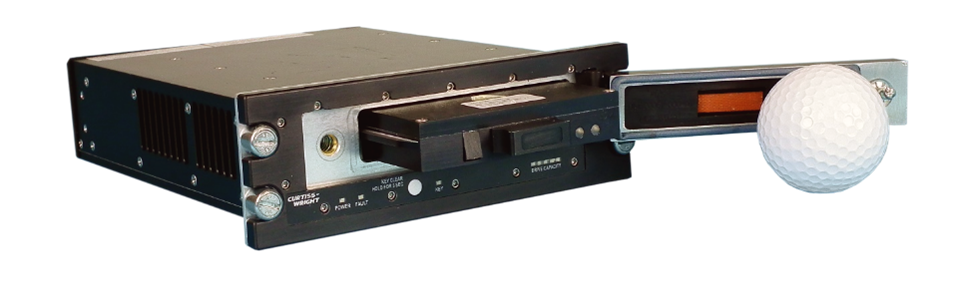
The white paper focuses on data at rest (DAR) devices known as network attached storage (NAS) or network file servers. These network attached storage devices are Ethernet-based and allow network clients to use the device as local storage. A network attached storage example is shown in Figure 1.
This blog focuses on one of those considerations: flexibility. The other considerations are lead time, loaners, encryption, quality, reliability, export, cost, and risk. The perspective is that of a defense contractor in the United States.
Why does Flexibility matter?
For a U.S. defense contractor, the flexibility consideration may matter a great deal. The wrong decision will limit the possible use of the data at rest device on another program or vehicle.
The benefits of flexibility or re-use are listed below, and likely the reader can think of more reasons to support re-use.
- Training
- Spare parts or systems
- Cost per unit
- Non-recurring engineering (NRE) avoidance
NOTE: All the following benefits apply to network attached storage devices, whether designed by in-house personnel, by a subcontractor, or by a COTS vendor.
Training
With any new device or system, the training consideration will have two aspects:
- Design personnel
- Maintenance personnel
Design personnel
Design personnel are those engineers and planners responsible for the vehicle architecture and all the systems and subsystems. While network protocols (NFS, CIFS, FTP, HTTP, iSCSI) are all industry standards, each network attached storage device will have its unique interface. The network attached storage example in Figure 1 has a unique command line interface (CLI).
The CLI is accessed through either the gigabit Ethernet (1GbE) ports or the serial RS232 port. The CLI includes 30 commands that control device administration, login authentication, port configuration, video stream control, removable memory cartridge reset, front panel control, and many other functions.
A person can send commands using a simple ASCII terminal emulator or ASCII scripts. The terminal emulator mode is usually used for initial training and familiarization. The scripts are embedded into the system for control during vehicle deployment. All functions of the example network attached storage can be controlled by the CLI.
Once learned, experience design personnel could quickly re-use the same example network attached storage in a new system. Existing scripts could be re-used that have been proven to work in deployment. Such re-use would save time and money.
Maintenance personnel
The same arguments hold for maintenance personnel. The difference is that maintenance personnel would not write scripts to control the network attached storage during use or deployment.
Maintenance personnel does need to check the network attached storage system before and after missions. They would use the built-in test (BIT) and similar commands to test the network attached storage.
They may also be asked to update the software in network attached storage. The updated software can be received by email and injected into the network attached storage with a particular command. Software updates would likely be performed at a service or maintenance depot.
Once you understand how to maintain a network attached storage, it would be beneficial to re-use the network attached storage to take advantage of the existing training and experience.
Spare Parts and Systems
Spare versions of any network attached storage device (or any device) must be purchased to support the deployed vehicle. A device may need to be removed for a variety of reasons.
A device may stop operating due to an internal failure. So, a spare must be inserted in the place of a dead device.
A device may act intermittent or unreliable. This status may be found by the device itself during the BIT operation. Again, a spare unit must be inserted in place of the flaky device.
A device may need to have the software updated. A software update may be required to an issue discovered or may be dictated by a regulatory agency like National Information Assurance Program (NIAP), which may have found a vulnerability with the encryption system. The network attached storage device will almost certainly have to be removed and returned to a depot for the software update. In that case, a spare unit will be inserted in its place to keep the vehicle operating.
Cost Per Unit
The cost per unit can be reduced if a network attached storage device is flexible enough to be re-used in another vehicle or application. Flexibility may result from various network protocols being designed into a network attached storage device. The example network attached storage supports many network protocols, including NFS, CIFS, FTP, HTTP, PXE, iSCSI, and RTP. This adaptability or flexibility allows the network attached storage to be used in many applications from UAV, USV, UUV, fighter, helicopter, and ISR.
For in-house designed and built network attached storage devices, the cost per unit will decrease as more units are manufactured simultaneously. If the electronics manufacturing is available in-house, the volume production will show up just the same as if the unit were built by an external contract manufacturer (CM).
This ‘economy of scale’ holds for units purchased from a COTS vendor. COTS vendors will offer volume discounts if you buy more than a few of one network attached storage device. Most COTS vendors use CMs to build their network attached storage devices. The volume discounts from the CM are passed along to the end customers.
As the flexible network attached storage device is designed into more systems, the volume of purchases increases, and discounts are available.
NRE Cost Avoidance
If a flexible network attached storage is re-used in more systems, a new network attached storage does not have to be designed. This means that no NRE will have to be expended. That capital can then be invested elsewhere in the company.
A side benefit of re-using an existing network attached storage device (and thus no NRE) is that technical risk will be reduced. New designs always have technical risks. Sometimes those flaws can show up late in the program or even during deployment. Technical risks affect the program schedule.
Summary
Whether a network attached storage device is designed by in-house personnel, an outside design contractor, or a COTS vendor, always consider the possibility of re-use of the network attached storage device.
Ask yourself some questions:
- Does the network attached storage fit only the current program needs?
- Does it have protocol support that might be used in other programs?
- Does it support basic protocols like NFS, CIFS, FTP, and HTTP?
- Can the network attached storage device support remote booting of network clients using PXE?
- Can the network attached storage support block transfers using iSCSI protocol?
- Can the network attached storage accept H.264 files from cameras via RTP?
- Can the network attached storage be monitored with SNMP?
A flexible network attached storage device re-used in multiple programs will provide long-term benefits in training, maintenance, cost per unit, and NRE cost avoidance. Benefits like these will add up for your company over time.
[1] Built-in test may also be known as built-in self-test (BIST)