So it’s vital these flight recorders can survive almost any crash. But what makes them so resilient? The answer is they must pass a series of strict tests that ensure accident investigators have the data to make recommendations to improve future flight safety. International standards define these tests, which are broadly separated into:
- Mechanical: Physical damage like impacts and crushing
- Thermal: Heat damage from fires
- Fluids: Damage from seawater and corrosive aircraft liquids
Once a flight recorder passes these tests, it should survive most catastrophic scenarios.
Defending Data from Physical Damage
The first layer of defense a flight recorder provides is against physical damage. The goal is to protect the internal memory chips from mechanical forces. The tests flight recorders must pass aim to simulate the conditions of an aircraft crash, which are defined in standards such as EUROCAE ED-112A.
Table 1 shows the mechanical tests the recorder must pass to meet this standard.
| Test | Force |
| Impact shock | 3,400 G for 6.5 ms |
| Penetration resistance | 500 lb from 10 ft with a ¼ inch contact point |
| Static crush | 5,000 lb for 5 mins per axis |
| Shear/tensile strength | 6,000 lb for 1 minute each axis |
Table 1: Selected environmental tests a flight recorder must pass to meet EUROCAE ED-112A
1. The Impact Test
Flight recorders must first withstand a massive impact, typically around 3400 Gs (g-forces) for at least 6.5 milliseconds. This shock simulates the violent deceleration experienced during a high-speed crash.
2. The Puncture/Static Load Test
An impact from a sharp object during a crash could penetrate the recorder's casing and smash the memory. To simulate this potential threat, a hardened steel pin is dropped from a defined height onto the recorder. This test, sometimes combined with a sustained static load on the pin, assesses the recorder's ability to resist the kind of penetration dangers that can occur.
3. The Crush Test
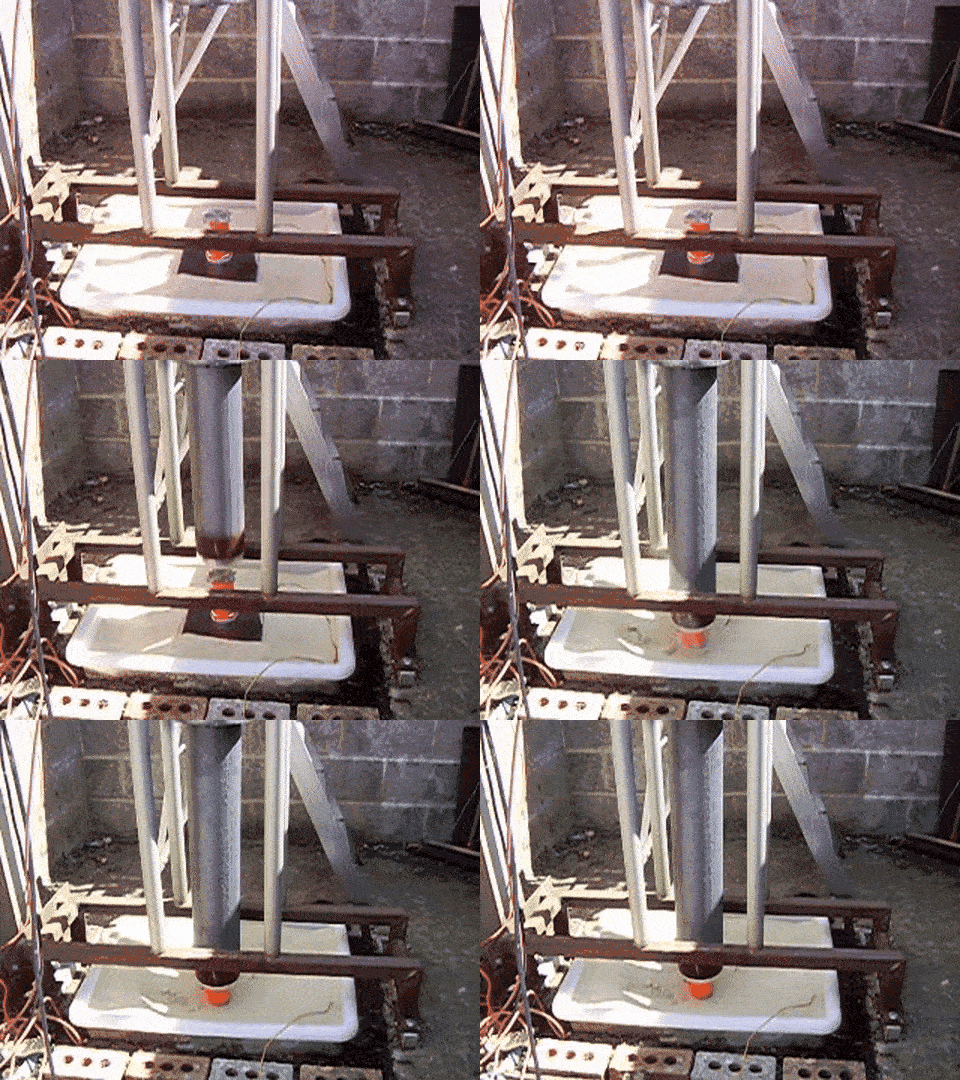
Following the initial impact, a recorder could experience immense static pressure from debris. The crush test simulates this by applying a substantial static weight, often around 5,000 pounds (2268 kg or 22,250 Newtons approximately), on each of the six principal axes of the recorder. This prolonged pressure ensures that the internal circuitry and recording media aren't deformed or damaged.
4. The Shear Test
This test ensures the underwater locator beacon (ULB) stays with the crash tube. The ULB sends out a vital signal for locating it underwater, so it's essential it stays with the recorder and isn't knocked off by an impact. The tests require static shear and tensile tests with a force of approximately 27 kN (6,000 lb). The test passes if the ULB remains attached to the flight recorder shell and the shell doesn't rupture.
Protecting flight recorder storage against mechanical damage
Designing mechanical protection to meet all these challenges is not technically difficult. You could construct a large steel and concrete box that would easily survive the most violent incidents. The challenge is to produce a compact and light design that has the performance to meet all the tests while satisfying the limited weight and space requirements for an aircraft.
The two typical materials used for the protective casings are titanium and stainless steel. Both metals are solid, with titanium having a better strength-to-weight ratio. Stainless steel is cheaper and thus a better choice when weight is less of a consideration than cost. It is also possible to make this material choice optional so that an end-user can decide to trade off weight and price. Still, the downside of this approach for a manufacturer is that it will require two sets of tests and two different products to manage, which may remove much of the cost-benefit.
There are different schools of thought about what shapes to use – cylinders, cubes, and spheres are all possible geometries that can work. It is also possible that the crash box will be an irregular shape, most likely if it needs to fit into a specific space on an aircraft. As with other aspects of the recorder, the exact materials and design approach used is open to consideration as long as the authorities are satisfied that the mechanical tests are passed.
How Flight Recorders Survive an Inferno
After a flight recorder has survived the impact, penetration, and crushing forces encountered in a crash, fire may quickly surround it. The danger is now that the circuit cards and components, including the solid-state memory that holds the precious flight audio and data, can be damaged by high temperatures.
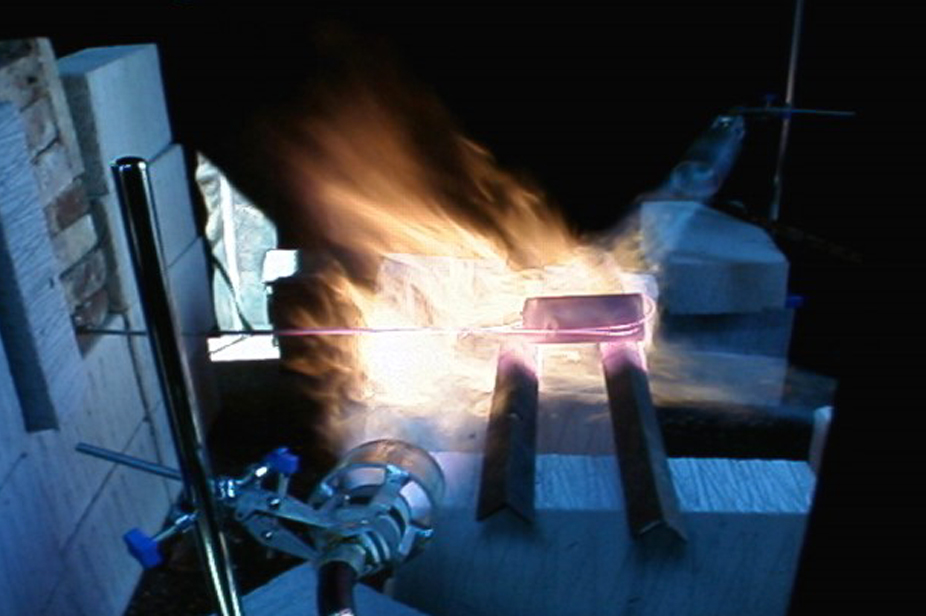
To ensure the data survives, a set of thermal tests are used to simulate exposing a flight recorder to burning jet fuel (which means high temperatures, but for a short time) and burning debris such as seats and luggage (i.e., a lower temperature, but for a longer time). These tests are:
- High: 1100°C for 60 minutes
- Low: 260°C for 10 hours
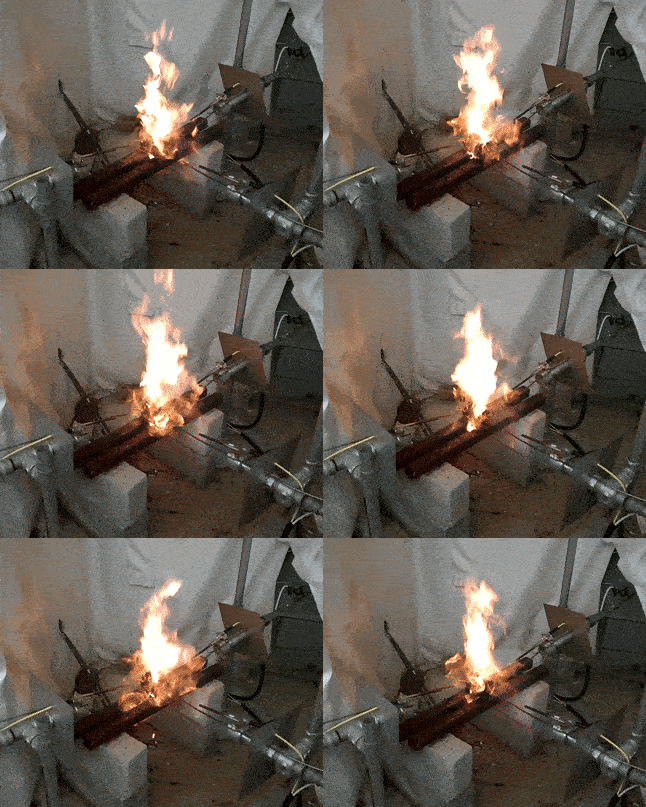
Such high temperatures and long durations mean significant thermal protection is required. Many suitable materials can insulate the storage media, but the challenge is to find one that combines a high insulation value with a low thickness and weight.
Otherwise, the quantity required would make the recorder too large and heavy for use on an aircraft.
An example of a material technology combining low mass with high thermal performance, is a phase change material. This substance absorbs heat as it transitions from one state to another (e.g., from a solid to a liquid). The energy needed to transition to that state is enormous, so the material is able to absorb and store tremendous heat energy before its state changes.
In practice however, selecting a suitable material can be difficult as most effective materials are patented. So, to avoid paying a licensing fee, designers must either use a limited range of non-patented materials, or develop their own material (which requires a significant investment of time and money).
One important side note to consider with thermal protection is that stopping heat from getting from the outside into the storage chips also traps any heat generated inside. All electronics heat up when powered, so it's possible that heat can build up inside a crash tube over a long period to a level where it starts to damage the electronics' design life. A good approach is to limit the amount of electronics inside the tube by moving as much control circuitry away from the chips as possible.
How do Flight Recorders Survive Underwater?
The effects of fluids and high pressure can be devastating to flight recorder’s memory. Just like for mechanical and fire threats, special tests are used to simulate the conditions a flight recorder might face following an accident over water, or if the recorder is submerged in aircraft fluids. Accident investigators also typically need additional help finding flight recorders lost in large bodies of water (i.e., the sea, lakes, and rivers).
Fluid tests and locating underwater recorders
Two immersion tests are used to check that a recorder can prevent fluids from reaching the memory module. The first involves immersing the flight recorder for 8 to 48 hours in aircraft fluids that are most likely to damage memory devices, including fuel, oil, and hydraulic fluids.
The second test simulates submerging a recorder in shallow sea water. It requires submersion in 3 m of seawater for 30 days at 25°C (77°F).
The third test simulates the conditions a recorder faces if it sinks to the sea floor for an extended time. The standard requires immersion in saltwater to the pressure found at 6,000 meters, or 20,000 feet, (60 MPa) for 30 days. This period can be reduced to 24 hours by proving that the recorder's protective materials are not affected by seawater.
| Test | Standard |
| Fluid immersion | Immersion in aircraft fluids up to 48 hr |
| Water immersion | 30-day seawater |
| Hydrostatic pressure | Equivalent to a depth of 20,000 ft |
During these tests, engineers must check for any signs of water penetration. After the tests and careful external drying, the internal components must be found free of any significant water ingress that could damage the recording media or the electronic circuitry.
Designing a flight recorder to meet these tests requires a tough crash tube, excellent seals, and corrosion resistance.
- Tough crash tube: The requirements are like those for mechanical protection. This means using robust materials that are thick enough and precision machined to create a strong shell that resists high pressures.
- Excellent seals: Seals are critical to preventing water ingress, and flight recorders typically use durable O-rings and gaskets to create watertight barriers around every possible entry point. These include the gaps (however small) around cables and any case joints.
- Corrosion resistance: Since even small amounts of liquids could damage a recorder's electronics by causing short circuits, internal components are often coated with thin layers of protective material. These conformal coatings act like a waterproof membrane and protect against moisture and corrosion.
Finding flight recorders in water
Underwater locator beacons (ULB) are vital for locating flight recorders in large bodies of water. They send out a signal that travels well in water and is distinct from most other natural sounds. Every ULB has its own battery, which must power it for 90 days once immersed in water. In addition to being securely mounted to a flight recorder, ULBs must also reliably activate upon submersion and then output a constant ultrasonic pulse for the full 90-day period.
The importance of protecting valuable flight data
It’s vital that the data flight recorders collect is available to crash investigators. Together with standards bodies, flight recorder manufacturers have made storage devices with truly incredible resistance to damage from physical forces, fire, and fluids, summaries in the table below. Organizations like Curtiss-Wright put all their recorders through a battery of harsh tests to make sure that air transport continues to get safer each year. Visit Curtiss-Wright’s flight recorder webpage to learn more about this essential technology.
| Test | Standard |
| Impact shock | 3,400 G for 6.5 ms |
| Penetration resistance | 500 lb from 10 ft with a ¼ inch contact point |
| Static crush | 5,000 lb for 5 mins per axis |
| Shear/tensile strength | 6,000 lb for 1 minute each axis |
| High temperature | 1100°C for 60 minutes |
| Low temperature | 260°C for 10 hours |
| Fluid immersion | Immersion in aircraft fluids up to 48 hr |
| Water immersion | 30-day seawater |
| Hydrostatic pressure | Equivalent to a depth of 20,000 ft |
Summary of important flight recorder environmental tests

Stephen Willis
Product Marketing Manager
Stephen Willis is the aerospace test and measurement Product Marketing Manager at Curtiss-Wright Defense Solutions. He has a degree in Electrical Engineering, a Masters in Philosophy for research in mathematical models and their market application for risk assessment, and a PG Dip in marketing and management. His current research interests include data acquisition, recording, and control systems and their applications in enabling a cost-effective route to gather large amounts of data. In particular, applications of interest include flight test, crash-protected recording, and structural/usage monitoring programs. He is the author of several academic papers and magazine articles.