The artificial intelligence (AI) industry is moving on from the giant, power-hungry models that dominate today’s military AI platforms. The Department of War (DoW) is being sold 2024 architecture to solve 2027 problems. Let’s take a look at what has changed and why it matters to an AI-first force. Then examine five proven techniques that let you get equal or better AI performance using a fraction of the memory, power, and hardware.
The Problem in Plain English
Think of today’s big AI models like a Walmart: huge, and you can get everything there, but they are the opposite of a specialty supplier. Current military AI platforms run on “dense” models - systems where every part of the AI’s brain fires for every single question you ask it. Ask it to identify a vehicle in a drone feed, and it activates the same neurons it uses to write poetry and explain memes. That’s wildly inefficient. These models need hundreds of gigabytes of specialized memory, racks of GPUs drawing tens of kilowatts, and usually a fat pipe back to a cloud data center. That’s fine at headquarters, where the horsepower is needed for training. It’s a liability at a company command post in a denied, degraded, intermittent, and limited (DDIL) environment.
The AI industry has figured this out. Here are the five things they’re doing about it.
Five Techniques That Change the Math
#1: Lower Precision = Same Answers, Much Less Hardware
AI models store numbers. Those numbers used to be very precise - 32 bits per number. As it turns out, you can drop to four bits per number, and the AI gives you virtually the same answers. NVIDIA’s latest chips (Blackwell) are built for this natively.
What it means: A model that needed 810 GB of memory now fits in approximately 100 GB. Energy per answer drops by 25-50x. Same accuracy. Same answers. The model just stores its knowledge more efficiently, like recording an acronym instead of spelling the whole thing out every time.
#2: Smarter Memory Management (TurboQuant)
When an AI is having a conversation or processing a long document, it must remember everything it has already read. That “working memory” (called the KV cache) can actually use more memory than the AI model itself. Google just released a technique called TurboQuant that compresses this working memory by 6x with zero loss in quality. No retraining is needed, and it works with any model, not just Google’s.
What it means: Multiple analysts can query the same AI system simultaneously without needing to multiply the hardware. A system that needed four GPUs to support a team of analysts can now run on one GPU.
#3: Mixture of Experts - Only Use What You Need
Instead of one giant brain where everything fires at once, the new models work like a highly-coordinated organization: they have multiple specialists, and a router that sends each question to the right expert. A model might have 235 billion total parameters but only activate 22 billion per question - the ones relevant to that specific task.
| Model | Total Size | Active Size | Ratio | Released |
|---|---|---|---|---|
| Deep-Seek-R1 | 671B | 37B | 5.5% | 2025 |
| Qwen3-235B | 235B | 22B | 9.4% | 2025 |
| Llama 4 Scout | 109B | 17B | 15.6% | 2025 |
| Old-style dense | 70B | 70B | 100% | - |
Right now, foreign models top the list, but the technique is portable to any model to ensure sovereign training.
What it means: You get a smarter AI that uses less power and requires less hardware per question. It’s the difference between calling an all-hands meeting vs. going straight to the world’s leading expert in the subject.
#4: Speculative Decoding - A Fast Assistant for the Big Brain
AI generates text one word at a time, and each word requires a full pass through the model. That’s slow. Speculative decoding pairs a small, fast “draft” model with the bigger “verifier” model. The draft model rapidly proposes several words; the big model checks them all in a single pass. Accepted words skip the slow process. The output is mathematically identical – there is no loss of quality. Apple, Google, and Intel have all demonstrated 2- to 6-fold increases in speed.
What it means: Your AI answers come two to five times faster with no drop in quality. The small draft model can run on minimal hardware, and the verification can be performed on the larger system. Just as in human systems, junior analysts draft, and senior staff review, correct, and publish.
#5: Use the Right-Sized Model for the Mission
Here’s the most important point: the military doesn’t need an AI that can do everything. A general-purpose model trained on the entire internet can write fan fiction, plan vacations, and debate philosophy. Your warfighters don’t need any of that. What they need is a smaller model trained on the right data: joint doctrine, equipment databases, SIGINT formats, and terrain analysis.
IBM and Janes built exactly this in late 2025: a defense-specific model trained on curated military intelligence instead of the internet. Their rationale was blunt - most military information on the internet is wrong, so a model trained on it will confidently give you wrong answers about military equipment.
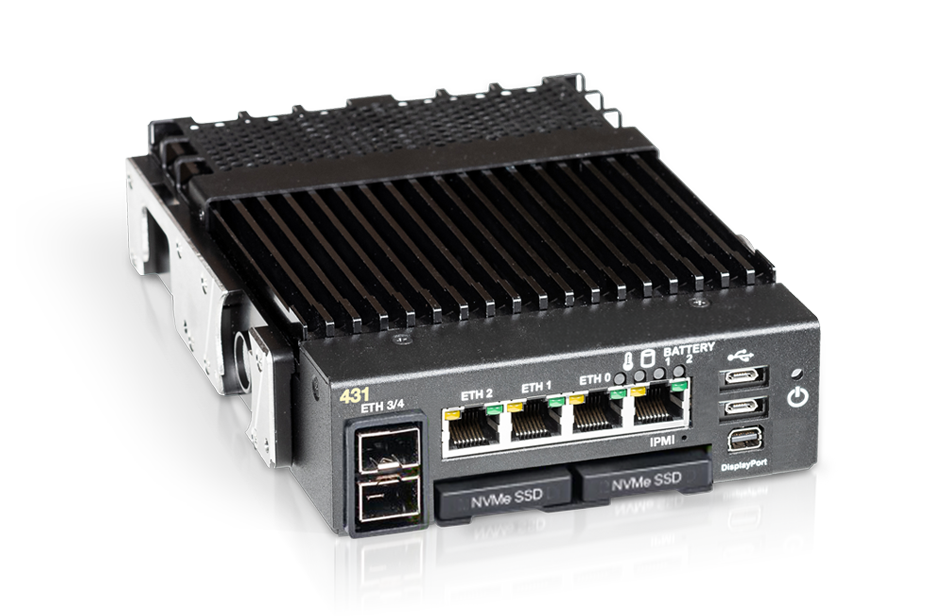
What it means: A 3-billion-parameter model fine-tuned on your domain fits on hardware the size of a paperback book and will outperform a 70-billion-parameter general-purpose model for the specific tasks your people actually do. It fits in a transit case, not a server rack.
Stack Them Up: The Compound Effect
These proven techniques aren’t five separate improvements - they multiply. Apply all of them, and you’re looking at AI systems that need 50-500x less memory and power than the dense-model architecture being fielded today.
| Model | Total Size | Active Size |
|---|---|---|
| Model memory | 140-810 GB | 2-20 GB |
| Working memory (KV cache) | 50-328 GB | 8-55 GB |
| GPU hardware | 4-8 data center GPUs | 1 edge accelerator |
| Power draw | 5-15 kW | 50-500 W |
| Connectivity required | Cloud reachback | Runs locally |
| Fits in | Server rack | Transit case |
None of these techniques eliminate the need for validation. Quantization, sparsity, routing, speculative decoding, and domain-specific tuning all need to be tested against the actual mission workload. But the direction is clear: the best-deployed AI systems will not simply be those with the largest models or the most GPU memory. They will be the ones that deliver useful answers under real constraints: power, bandwidth, latency, size, weight, classification, and disconnected operation.
What’s Coming Next: Agentic AI
By now, you have undoubtedly heard of agentic AI. All five of these trends help us move toward agentic systems - systems built not as a single giant model, but as a team of specialized AI agents coordinated by a controller. Again, like in human systems, the general or admiral sets the intent and tasks individuals or groups to achieve the larger goal. Agentic AI works in a similar manner, with each agent running a small model tuned for its specific job - imagery analysis, communications monitoring, logistics forecasting, and course of action (COA) development.
This maps naturally to how the military already operates. The architectural direction of commercial AI is converging with military operational design. The question is whether the DoW’s AI platform investments will enable this architecture or lock the force into a monolithic dependency that has to be ripped out in three years.
So What?
If you’re a leader evaluating AI capabilities for your formation, here’s what to take away:
- Don’t be impressed by parameter count. A 671-billion-parameter model that only activates 37 billion per question is more efficient than a 70-billion dense model. Bigger numbers on a slide don’t mean better capability for you.
- Ask about edge deployment. If the AI requires cloud reachback to function, it will fail you in a DDIL environment. Ask the vendor: what runs locally, on what hardware, at what power draw?
- Ask about the training data. A model trained on the internet will confidently give wrong answers about military systems. Domain-specific models trained on authoritative data are smaller, more accurate, and more secure.
- Ask about the architecture’s shelf life. Dense-model-only platforms are the AI equivalent of buying a fleet of vehicles right before the engine technology changes. Every major AI lab has moved to Measure of Effectiveness (MoE). The platform you are buying should support it.
- Ask to talk to the technologists. Vendor sales teams will show you polished demos. The real conversation is about what the architecture will look like in 2027-2028, when these efficiency techniques are standard, even though your current platform may not support them.
The AI Industry is moving past the monolithic architecture; make sure DoW acquisitions follow suit. They are shipping in commercial products right now. The force deserves AI that fits where it fights.
Dominic Perez is the Chief Technology Officer of Curtiss-Wright Defense Solutions. He can be reached for deeper discussion on AI architecture trends shaping military systems in 2027 and beyond.

Subscribe Today!
Subscribe to our blog and receive a monthly email that keeps you up-to-date with the latest news and insights from Curtiss-Wright.

Dominic Perez
Chief Technical Officer
Dominic Perez joined Curtiss-Wright in 2008 as part of the company’s Quality Department. He took an active role in product development and was part of the team that created the first small form factor (SFF) PacStar 1200-Series modules which evolved into the industry-leading PacStar 400-Series product line. In 2013, he led the Quality Systems and Networking Engineering departments, which among other responsibilities created the PacStar Secure Wireless Command Post (SWCP). He was promoted to Vice President of Systems Engineering in 2020 and tasked to lead the development of the company’s next generation of integrated solutions. In 2021, he was promoted to Chief Technical Officer and appointed a Technical Fellow at Curtiss-Wright.