
PacStar MRC is a COTS-based, modular, rugged radio, voice, and IP-integrated solution that brings together popular U.S. DOD and civilian radios in compact, expeditionary configurations—ideal for soldier-carry, fly-away, or vehicle-mounted deployments. Combined with the PacStar 400-Series line of deployable modular compute and communications hardware, PacStar MRC can be customized to meet virtually any tactical or deployed communications requirement.
The latest additions to the PacStar 400-Series, PacStar 466 and PacStar 467 tactical radio gateways, make it easier than ever to connect almost any mix of civilian and military radios to a tactical IP network. These rugged, compact modules deliver seamless communications across teams, services, and domains, extending the flexibility that PacStar customers already rely on. If you know Curtiss-Wright’s PacStar products, you know that modularity and interoperability are at the core of the product line. With these two new Radio over IP (RoIP) gateways, that flexibility goes even further—bridging legacy radios with IP-based communications, extending networks, and creating unified voice channels across previously isolated systems.
Making Radio Interoperability Simple — and Fast
Until recently, getting different radio systems to talk to one another was complex, often requiring specialized training and equipment. PacStar 466 and 467 change that. They’re designed for plug-and-play simplicity, minimal setup time, and maximum interoperability—all in the smallest and lightest footprint possible.
What does that mean in practice?
- Users can set up and connect a radio network in minutes, even with only light training
- The touchscreen-enabled interface makes configuration intuitive and accessible
- With broad support for both military and commercial radios, the system delivers flexibility in any environment
Whether the mission calls for voice convergence, network extension, or radio cross-banding, these gateways bring every channel into one cohesive network—ensuring smoother coordination, faster responses, and fewer communication gaps in denied, disrupted, intermittent, and limited (DDIL) environments.
PacStar 466: Powered by Parraid NRG5

PacStar 466 is powered by Parraid’s proven Network Radio Gateway (NRG5™) technology, enabling a decentralized, mesh-based network of gateways and clients.
This architecture supports voice and data over legacy U.S. military Combat Net Radio (CNR), Joint Tactical Radio System (JTRS), and commercial Land Mobile Radio (LMR) systems—providing unmatched interoperability and resilience.
Unlike older hub-and-spoke systems that create single points of failure, the mesh design ensures communication continues even if a node goes down. It’s resilient, adaptive, and built for mission continuity under the most demanding conditions.
PacStar 467: Integrated SyTech RADIUS Technology

PacStar 467, built on SyTech’s RADIUS software technology, delivers an all-in-one communications interface that connects radios, computers, smartphones, and mesh devices. It bridges two-way radios across HF, VHF, UHF, and 700/800 MHz bands while integrating modern IP-based communication tools.
This technology allows operators to link radios, laptops, and mobile devices into a single, unified tactical network that spans every layer of the mission—supporting both legacy and next-generation platforms.
PacStar 466 and 467 address traditional interoperability challenges while meeting the growing need for integrated IP communications in modern missions.
Designed for the Tactical Edge
Every element of these gateways is optimized for deployment at the tactical edge—where time is short, conditions are harsh, and adaptability is key.
Each connects to a variety of radios using standard interface cables, while Ethernet ports form the backbone of the RoIP network. Curtiss-Wright’s OEM-developed software enables remote configuration and management of multiple radio types, allowing for quick, consistent setup across platforms.
In short, warfighters at any echelon can now deploy RoIP rapidly and confidently. The result is faster setup, improved interoperability across legacy and modern radios, and reliable communication even in austere environments.
More Interoperability, Less Complexity
Both gateways stand out by combining ease of use with powerful capability.
Legacy RoIP systems required technical expertise to operate. By contrast, PacStar 466 and 467 are designed for quick setup and intuitive management—even by lightly trained users. Their touchscreen interface simplifies the connection between multiple radio networks, regardless of diversity or distance. Support for industry-standard protocols and applications—including SIP, H.323, multicast, unicast, WAVE, ICE, TALKNET, Cisco CallManager, and LTE radio interfaces—ensures these gateways integrate seamlessly into existing and emerging architectures.
Network administrators want to be able to communicate across different communications systems, and experience enhanced reliability and redundancy of those systems. They also need simplified network management. The expanded PacStar MRC give this to them and is a system that’s more interoperable and configurable than ever before, capable of connecting up to 12 different radio networks simultaneously.
A Trusted Ecosystem, Expanded
As part of the PacStar 400-Series, PacStar 466 and 467 fit directly into the broader PacStar MRC ecosystem, allowing organizations to expand capabilities without replacing existing infrastructure.
PacStar MRC is built to scale—from a single module to multiple transit cases equipped with radio chassis, radio brackets, and PacStar Smart Chassis for IP networking and data processing. Adding PacStar 466 or 467 extends that scalability, giving customers more ways to design and deploy mission-ready communications architectures.
By combining these RoIP gateways with other PacStar 400-Series modules—routers, switches, servers, and management systems—users can create scalable hybrid radio and IP solutions tailored to their operational needs.
Real-World Mission Applications
The versatility of PacStar 466 and 467 enables a wide range of mission use cases.
For example, PacStar MRC—when combined with these gateways—can support Mobile Ad Hoc Networking (MANET) over a Wide Area Network (WAN) by pairing tactical radios with PacStar router and server modules. This combination allows persistent connections to the tactical WAN across radios such as L3Harris AN/PRC-163, Persistent Systems MPU5, Silvus Streamcaster SC4200EP, and TrellisWare TW-900/950.
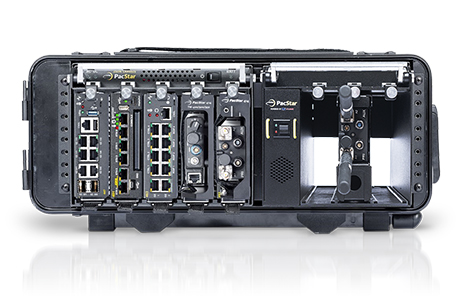
PacStar MRC can also interface with Curtiss-Wright’s TCG HUNTR Tactical Data Link (TDL) hub, enabling secure data transmission from ground units to aircraft — a vital function for joint air-ground operations and Marine air support missions.
These interoperability capabilities ensure teams on the ground, in the air, or across coalition networks can all share voice and data in real time — securely, reliably, and efficiently.
Breaking Away from Legacy Limitations
The PacStar 466 and 467 move beyond the legacy, centralized hub-and-spoke RoIP designs that often created single points of failure and required complex setup.
Instead, Curtiss-Wright delivers decentralized, resilient, and highly interoperable architectures that meet the realities of modern defense operations. Units can connect, scale, and adapt communications on the fly—without relying on specialized support or heavy infrastructure.
The Next Evolution in Tactical Communications
With PacStar 466 and 467, Curtiss-Wright continues to evolve the PacStar MRC to meet the fast-changing demands of modern warfare. These new RoIP gateways empower warfighters with faster setup, broader interoperability, and greater flexibility. They bridge legacy and IP-based radios, enhance real-time situational awareness, and ensure secure, seamless communication across domains—all within the rugged, proven framework of the PacStar 400-Series.
In today’s operational environment, connecting any radio, anywhere, at any time isn’t just an advantage—it’s essential.
And with PacStar 466 and 467, that capability is now firmly in the hands of every network administrator at the tactical edge.
Find out more about PacStar Modular Radio Center here.

Subscribe Today!
Subscribe to our blog and receive a monthly email that keeps you up-to-date with the latest news and insights from Curtiss-Wright.

Mike Southworth
Senior Product Line Manager
Mike Southworth is Senior Product Line Manager for Curtiss-Wright Defense Solutions. He has 25+ years of experience in technical product management and marketing leadership roles. Mike holds an MBA from the University of Utah and a Bachelor of Arts from Brigham Young University.


