
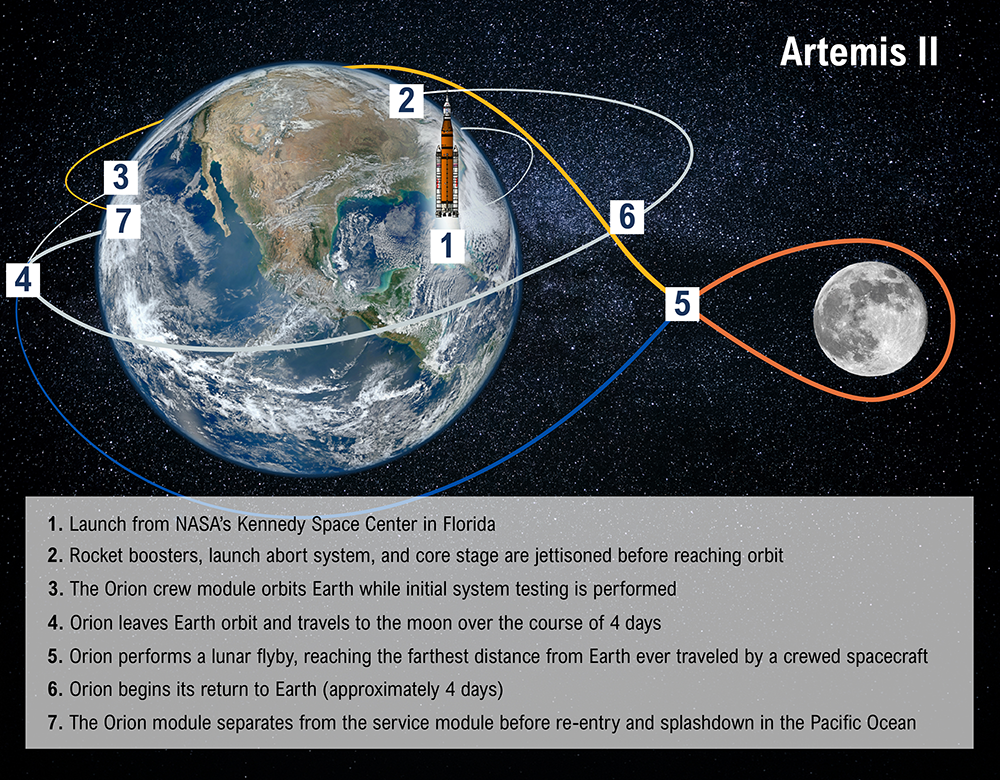
The historic Artemis II flight’s successful mission marks the first time in over fifty years that we have traveled to the moon, and the furthest humans have ever been from Earth. This mission was a critical stepping stone for the Artemis IV mission which aims to once again land people on the moon’s surface. Curtiss-Wright was proud to contribute to this effort with our Space COTS.
One of the barriers to space has been the high cost. Getting to, and surviving the space environment, is challenging and risky. This is also true for all the electronic systems used for navigation, control, and monitoring. Technology has advanced dramatically since the Apollo era. A modern calculator has far more processing power than the computers that helped guide astronauts to the Moon.
However, in space, fast is secondary to robust. For decades, that meant every screw, chip, and circuit was custom-built at a massive cost. But for recent space missions, including Artemis, this practice has changed, and the industry has embraced space COTS.
What is Space COTS?
COTS stands for commercial-off-the-self. Traditionally, space hardware was bespoke – built from scratch for maybe a handful of missions. Today, rugged versions of commercial systems are more common. This transition mirrors the defense sector’s shift in the 1990s, driven by a need to lower costs, deploy faster, and access cutting-edge tech.
There are a few reasons why it took a long time for space COTS to gain acceptance:
- Radiation: Commercial electronics usually aren’t designed to survive the increased radiation experienced outside Earth’s atmosphere
- Traceability: You need to know exactly where every sub-component was manufactured to make sure the hardware is genuine and meets quality requirements
- Obsolescence: Space projects take years to go from design to deployment, commercial electronics could easily stop making important parts halfway through a 10-year project
- Reliability: Most manufacturers don’t design hardware to handle the violent vibrations of a rocket launch, the vacuum of space, or the extreme temperature changes.
A key breakthrough came from the flight test instrumentation (FTI) industry. These systems were already designed to capture and process data reliably in harsh terrestrial environments. Aircraft programs also need obsolescence management and part traceability. All that was missing was radiation resistance.
By shifting from radiation-hardened (built to be invincible) to radiation-tolerant (built to handle acceptable risk with smart redundancies), and using program-specific qualification programs, a large library of existing COTS hardware became available to space launchers and vehicles.
Curtiss-Wright Space COTS on the SLS and Orion
Curtiss-Wright supplied some of our space COTS products for the Space Launch System (SLS) and Orion capsule:
- On NASA’s SLS: Curtiss-Wright hardware supports the rocket’s core stage data acquisition system. These systems gather and process performance data during flight, helping engineers understand how the vehicle behaves in the real world and verify analytical models against actual mission conditions. That kind of instrumentation is essential not only for mission assurance, but also for improving future missions.
- Inside the Orion spacecraft: Our space COTS products support lifecycle instrumentation. These systems capture sensor data from key structures and components across different mission phases and environments. That data helps engineers assess structural integrity, correlate models to real-world performance, investigate anomalies, and support decisions around component reuse and long-term system confidence.
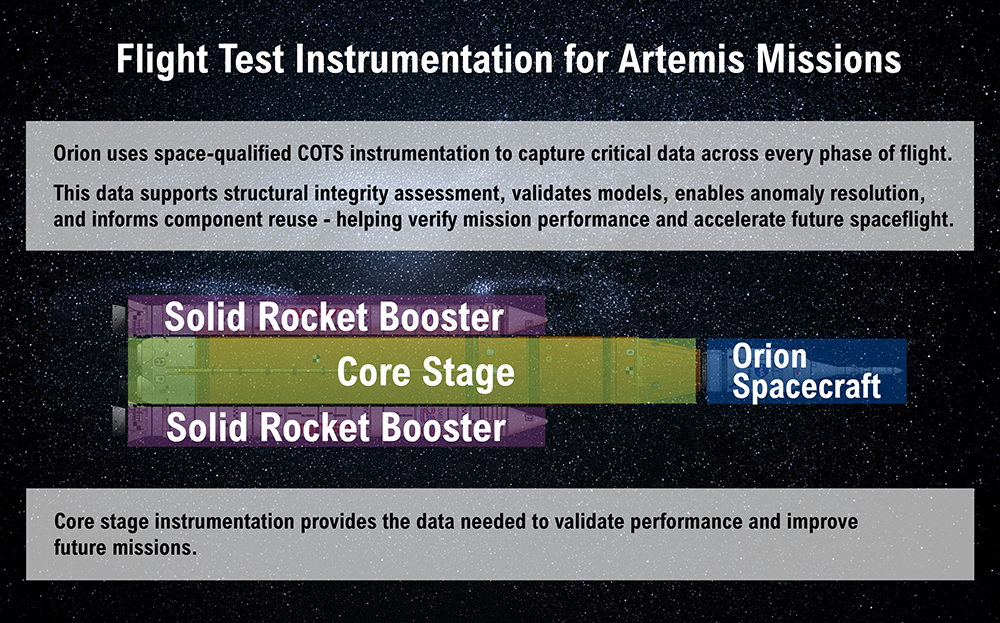
Acquiring high-quality test data from space launchers and vehicles is the only way to bridge the gap between theory and reality. By providing well-proven systems that benefit from faster technology cycles and lower costs enabled by space COTS, Curtiss-Wright helps engineers capture every vibration, temperature spike, and pressure fluctuation during tests. Ultimately, this data helps identify issues that may compromise mission success.
The Road Ahead: From the Moon to Mars
The industry has spent many years evolving space COTS to the point where it is ready for the moon. In the coming decades, this trend should continue, and perhaps in the late 2030s, the same commercial-based tech might just be on its way to Mars. You can learn more about Curtiss-Wright’s space COTS here.
The same forces reshaping aerospace and defense more broadly - faster innovation cycles, pressure to control cost, and the need to field capability sooner - are now reshaping space. Missions to the Moon are helping prove that commercial-derived technology can play a meaningful role even in the harshest environments.
That matters because the journey does not end with Artemis II, or even the Moon. The lessons being learned now will help the next generation of lunar systems, deep-space missions, and eventually Mars exploration. The path to Mars will demand technology that is not only advanced but also practical, scalable, and proven. Space COTS is becoming an important part of that future.

Subscribe Today!
Subscribe to our blog and receive a monthly email that keeps you up-to-date with the latest news and insights from Curtiss-Wright.

Stephen Willis
Product Marketing Manager
Stephen Willis is the aerospace test and measurement Product Marketing Manager at Curtiss-Wright Defense Solutions. He has a degree in Electrical Engineering, a Masters in Philosophy for research in mathematical models and their market application for risk assessment, and a PG Dip in marketing and management. His current research interests include data acquisition, recording, and control systems and their applications in enabling a cost-effective route to gather large amounts of data. In particular, applications of interest include flight test, crash-protected recording, and structural/usage monitoring programs. He is the author of several academic papers and magazine articles.