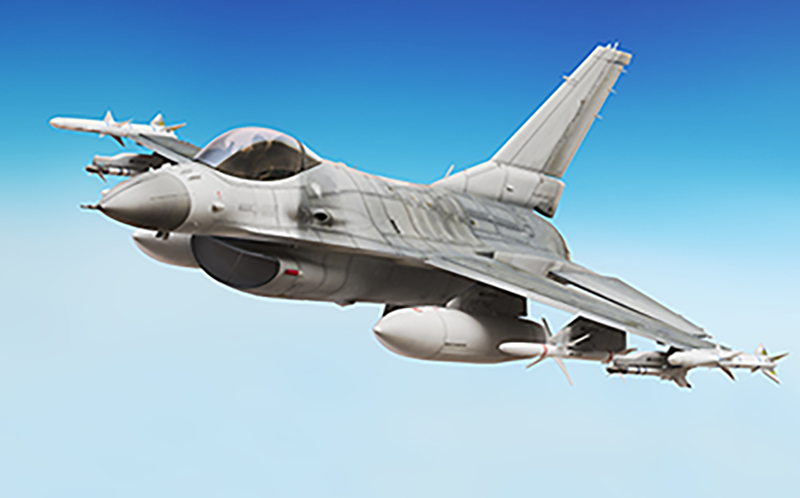
Flight test campaigns are essential for verifying and validating aircraft performance, safety, and reliability under real-world conditions. Engineers conduct them to ensure that new or modified aircraft meet regulatory standards and design requirements before entering service. During these campaigns, data collection is everything. You need to capture detailed information to confirm compliance, identify issues, and inform further development or certification decisions.
Flight test instrumentation (FTI) systems capture a lot of this data using analog sensors – strain gauges, thermocouples/RTDs, pressure transducers, etc. These are connected back to a data acquisition unit (DAU) using copper wires, which convert them into digital data for storage, transmission, and data analysis. This works perfectly well, but another sensor technology is quickly gaining interest in the community – Fiber Bragg Grating (FBG).
What is a Fiber Bragg Grating Sensor?
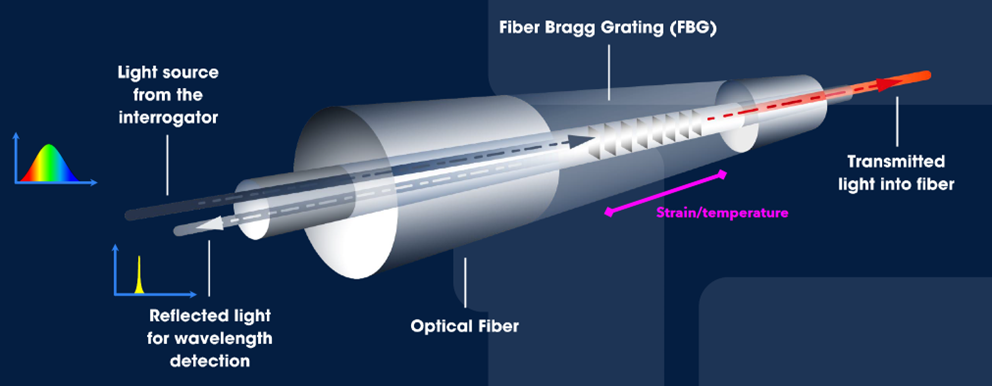
At its simplest, an FBG sensor is an optical fiber with one or more microscopic "filters" etched into its core. Using a lightsource, the periodic variation in the fiber core's refractive index can be detected. When you send a broad spectrum of light down that fiber, this "grating" reflects a very specific wavelength (the Bragg wavelength) and lets everything else pass through.
The magic happens when the fiber is stretched or heated. The spacing of that internal grating changes, which shifts the reflected wavelength. By measuring that shift, we can calculate strain or temperature with incredible precision.
What’s so Grate about Fiber Bragg?
FBG sensors are well-suited for FTI systems because they are lightweight, immune to electromagnetic interference, and capable of collecting a huge amount of data from multiple parameters—such as strain and temperature—along a single fiber. Together with the integration of AI based analysis this leads to more precise and quicker insights. Their small size allows for easy integration into aircraft structures without adding significant weight or complexity. Additionally, they can be quicker to install than traditional alternatives, offer good mechanical and thermal resistance, and pose no grounding or sparking risks due to their electrical passivity.
You can also embed these fibers directly into composite structures, such as wings. Composites pose some challenges for traditional sensors, compared to metal ones, for several reasons, including:
- Complex layered construction: Their strength and stiffness vary with direction
- More uneven surfaces: Surface preparation and adhesive bonding are more difficult
- Increased sensitivity to damage: Drilling is more likely to compromise structural integrity
So FBG sensors have many advantages, but that's not to say there aren't disadvantages. One of the historical limitations of FBG technology has been the size and weight of the interrogator, together with the limited ruggedization of both the interrogator and the sensors. Traditional sensors output an electrical signal that DAUs can easily read. However, FBGs use light as both an input and an output. The interrogator provides the optical interface to the FBG sensors: it generates and receives the light, detects wavelength shifts, and converts them into digital data that can be processed, transmitted, and recorded.
Today, these size and ruggedization challenges have largely been overcome. Modern FBG systems are optimized for SWaP and are available with full MIL-STD and DO-160G qualification for interrogators, cables, and sensors.
On the Practicalities of Integrating FBG Sensors into Today’s FTI System
In the near term, FTI engineers should treat FBG sensors like any other new sensor. They are not going to change FTI systems or replace all the traditional sensors dramatically. Instead, they will bolt on to existing systems, replacing some analog sensors, or bring additional data collection possibilities for applications like:
- Temperature/stress maps for wings, rotor blades
- Embedded in surfaces to collect usage/loads monitoring data
- Overhead detection on engines
That's all to say that the FBG interrogator needs to integrate with other data acquisition systems and meet other common FTI hardware requirements to be most useful today. These requirements include:
- Supporting standard FTI data formats (iNET-X, IENA, DARv3, Chapter 10/11 UDP, TmNS)
- Accurate time-stamping (such as PTPv1, PTPv2)
- Low SWaP
- High reliability and environmental ruggedness
- Configurable via standard FTI system setup software
Curtiss-Wright has been researching how best to implement FBG into larger FTI systems for many years and is pleased to be now working with an industry-leading technology expert – PhotonFirst. They have already developed several technologies for FBG applications, including in aerospace. Curtiss Wright and PhotonFirst are now collaborating to develop an FTI-optimized solution to meet the needs of flight test applications. Further product details will be announced closer to product launch.
The FBG Reality Check
Flight test engineers should embrace FBG technology for its promise to simplify installation, reduce wiring, and deliver precise, reliable data, greatly enhancing instrumentation capabilities for modern, complex aircraft structures—especially composites. Stay tuned to learn how implementing this practically into standard FTI data acquisition systems is becoming a reality.

Subscribe Today!
Subscribe to our blog and receive a monthly email that keeps you up-to-date with the latest news and insights from Curtiss-Wright.

Stephen Willis
Product Marketing Manager
Stephen Willis is the aerospace test and measurement Product Marketing Manager at Curtiss-Wright Defense Solutions. He has a degree in Electrical Engineering, a Masters in Philosophy for research in mathematical models and their market application for risk assessment, and a PG Dip in marketing and management. His current research interests include data acquisition, recording, and control systems and their applications in enabling a cost-effective route to gather large amounts of data. In particular, applications of interest include flight test, crash-protected recording, and structural/usage monitoring programs. He is the author of several academic papers and magazine articles.