They might be the ones you hear, ping, or broadcast. Electromagnetic signals from radios, radars, and sensors create a digital footprint that can reveal a unit’s position or signal an impending strike.
For years, the challenge for U.S. and NATO forces has been interoperability: how could they turn separate signals detected by a French sonobuoy, a British aircraft, and a U.S. ground unit into a single, actionable picture of the battlefield?
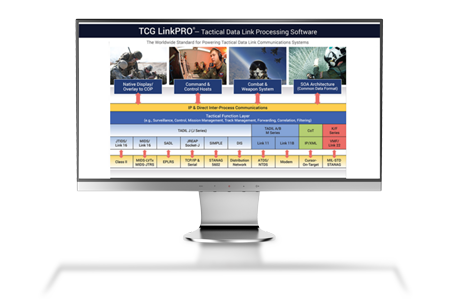
Curtiss-Wright has solved this puzzle by integrating Cooperative Electronic Support Measure Operations (CESMO) with TCG LinkPRO®, an integrated electronic warfare (EW) software solution that combines the CESMO API with TCG LinkPRO. This breakthrough enables allied forces to aggregate and share EW data in real time, creating a unified defense against sophisticated adversaries.
While CESMO has existed as a protocol, Curtiss-Wright was the first U.S company to offer this specific integration. By opening the API and merging it with TCG LinkPRO, we’ve created a gateway that allows organic sensor data (from ships, planes, and ground units) to flow seamlessly into the broader Link 16, JREAP, Link 22, VMF, and cursor-on-target (CoT) networks.
What Does It Do?
At its core, the system acts as a sophisticated translator and aggregator for the electromagnetic spectrum. It allows forces to:
- Detect and identify: It gathers signals of interest from various sources, such as radar, and analyzes their electronic signatures with high accuracy.
- Collaborate securely: Allied forces can share this data across different platforms to determine exactly what a threat is and where it is located.
- Kinetic targeting: Most importantly, it can forward this data to kinetic platforms, like artillery or naval vessels, to physically neutralize threats.
Bridging the Interoperability Gap
Historically, U.S. and NATO partners operated on different wavelengths, both literally and figuratively. There was a significant interoperability gap where EW data stayed trapped within the system that collected it.
Before this integration, sharing sensor data from an ad-hoc NATO network across a multi-tactical data link (TDL) interface was a manual, slow process. Now, TCG LinkPRO makes it possible to:
- Utilize ad-hoc sensor networks: Any NATO partner can contribute their organic sensor data to a shared pool.
- Automated forwarding: Aggregated data can be pushed automatically to the multi-TDL interface.
- Multi-frequency transport: Data can now be shared across multiple frequency paths, ensuring connectivity even in degraded environments.
A Specialized Ecosystem
This technology isn't just for specialized labs; it's for the warfighters on the ground, in the air, and at sea. Full-time EW professionals use the TCG LinkPRO-based TCG HUNTR® GUI to visualize the spectrum and identify enemy positions, protecting multi-million-dollar equipment from targeted attacks. Special Operations teams or infantry squads need to know if they’re being tracked. This system provides them with quick, simple situational awareness to keep their personnel safe. Signature management personnel who create and maintain digital signatures for detecting malicious code or unauthorized activities use the system to minimize their own electronic footprint, making their team harder to find and hit.
The beauty of the TCG LinkPRO CESMO integration is that it doesn't exist in a vacuum. It is part of a larger, robust ecosystem within the Curtiss-Wright family:
- Curtiss-Wright’s TCG HUNTR provides the baseline Graphical User Interface (GUI) that operators use to interact with the data.
- The software can be bundled with Curtiss-Wright’s Tactical Communications and Small Form Factor Networking Systems product lines for a rugged, portable, ready-to-go EW capability.
- For those looking for embedded solutions, this integration can be added to our VPX lineup to support CMOSS and MOSA open-architecture military standards.
The Bottom Line
The single most important takeaway is this: TCG LinkPRO CESMO enables U.S. and NATO forces to passively detect emissions and forward that data to kinetic platforms such as artillery or aircraft, to protect against attacks.
In the high-stakes world of electronic warfare, knowing where and who the enemy is in the spectrum is the difference between mission success and disaster. By bridging the gap between U.S. and NATO protocols, Curtiss-Wright has provided a tool that ensures allied forces are not just reacting to the modern battlefield—they are controlling it.

Subscribe Today!
Subscribe to our blog and receive a monthly email that keeps you up-to-date with the latest news and insights from Curtiss-Wright.

Steven Horsburgh, Ph.D.
Director of Product Management
Dr. Horsburgh is the Director of Product Management at the Tactical Communications Group of Curtiss-Wright Defense Solutions. After obtaining his Ph.D. in Physics, he has 36 years of research and development experience designing solutions to complex, large, data driven applications for commercial and military use. He has 18 years of experience with Tactical Data Links software design and development in both engineering and management positions. Prior to joining Curtiss-Wright, Steve worked in satellite communications and data management for the Naval Research Lab, Mission Research Corporation, and ATK and subsequently joined Tactical Communication Group, LLC (TCG) to architect, design and manage agile research and innovation projects related to Tactical Data Links including Link 16, Link 22, Link 11, JREAP, VMF, CoT, and CESMO.
