Have you ever driven through Atlanta, GA? Whether you sail through or sit in traffic depends on timing. Maneuvering from the far-left lane to make a right-side exit requires precise moves, lest you introduce yourself to another driver and a Georgia state patrol officer.
In modern aerospace and defense operations, timing is everything. Missions are planned down to the second, and one misstep can delay deployments, put sensitive data at risk, or compromise operational security. The same is true when integrating Commercial Solutions for Classified (CSfC) technologies, where even the slightest misunderstanding can stall programs for weeks or months, such as confusing an inner encryption layer with an outer encryption layer.
For organizations working under the National Security Agency’s (NSA) CSfC data-at-rest (DAR) architecture, getting the definition of inner versus outer encryption layers right isn’t just a technical detail. It’s the difference between compliance and rejection, readiness and delay, security and exposure.
This blog will break down the rules of CSfC DAR encryption, explain how data moves through the Red → Gray → Black security states, and share best practices for avoiding costly mistakes. The message for defense leaders and engineers is clear: misinterpretation = failure, compliance = mission assurance.
Why Inner vs. Outer Layers Matter in a CSfC DAR Architecture
The NSA’s CSfC program allows government and defense organizations to deploy secure systems faster using validated commercial products rather than relying solely on government-off-the-shelf (GOTS) solutions.
One of the most critical elements of a CSfC DAR architecture is the requirement for two independent encryption layers to protect classified DAR, one inner layer and one outer layer. These layers are not interchangeable, and their definitions carry legal and operational weight.
- Outer encryption layer = the first layer unlocked
- Inner encryption layer = the second layer unlocked
Confusing these roles can derail compliance. Teams that base their understanding on the wrong criteria, such as encryption order or data flow, often run into NSA rejection, costly redesigns, and mission delays. The consequences are severe in aerospace and defense, where schedules are often tied to multimillion-dollar contracts.
How to Define the Layers: The Authentication Order Rule
The authentication order, not the encryption sequence, defines inner and outer layers.
- Outer Layer: Must always be authenticated (unlocked) first
- Inner Layer: Must always be authenticated (unlocked) second
This is a subtle but critical distinction. For instance, some teams assume that the “first” encryption applied in a storage architecture is the outer layer. That’s incorrect. The NSA defines the layers exclusively by the order in which a user unlocks them during authentication.
This rule ensures compliance is based on a consistent operational standard rather than implementation nuances.
Understanding Data Flow: Red → Gray → Black
To fully grasp the role of each encryption layer, it helps to understand how data transforms through Red, Gray, and Black states:
- Red Data: Plaintext, unencrypted classified information
- Gray Data: Classified data after one layer of encryption
- Black Data: Classified data after two independent CSfC-approved encryption layers
The flow of encrypting data works like this:
- The inner encryption layer converts Red data into Gray data.
- The outer encryption layer then converts Gray data into Black data.

During decryption, the process reverses: the outer layer decrypts first, returning data to Gray, and the inner layer decrypts second, returning it to Red. This structured flow provides resilience. If the outer layer is compromised, the data remains secure behind the inner layer, meeting the NSA’s dual encryption requirement.

How to Determine When a System is Classified or Unclassified
Another area where organizations often trip up is determining when a system is classified or unclassified. Under CSfC DAR guidance:
- Powered off, no authentication = always unclassified
- Powered on, no authentication = still unclassified
- Outer layer authenticated = classified
- Both layers authenticated = classified
The rule of thumb is that once the outer layer is unlocked, the device is considered classified, even if the inner layer remains locked.
This distinction has practical implications for handling, transporting, and operating CSfC-compliant devices in aerospace and defense missions.
The Safe-in-a-Locked-Room Analogy
Rules and diagrams can illustrate a point, but nothing drives home the message like an analogy. One of the most effective is the “safe in a locked room” analogy:
- Room = outer layer (unlocked first)
- Safe = inner layer (unlocked second)
To access valuables (classified data), you must first unlock the room and then the safe. When securing valuables, you lock the safe first, then lock the room.
This mental model eliminates ambiguity, making the CSfC DAR architecture intuitive to decision-makers who may not be steeped in encryption protocols.

Real-World CSfC-Compliant Device Examples
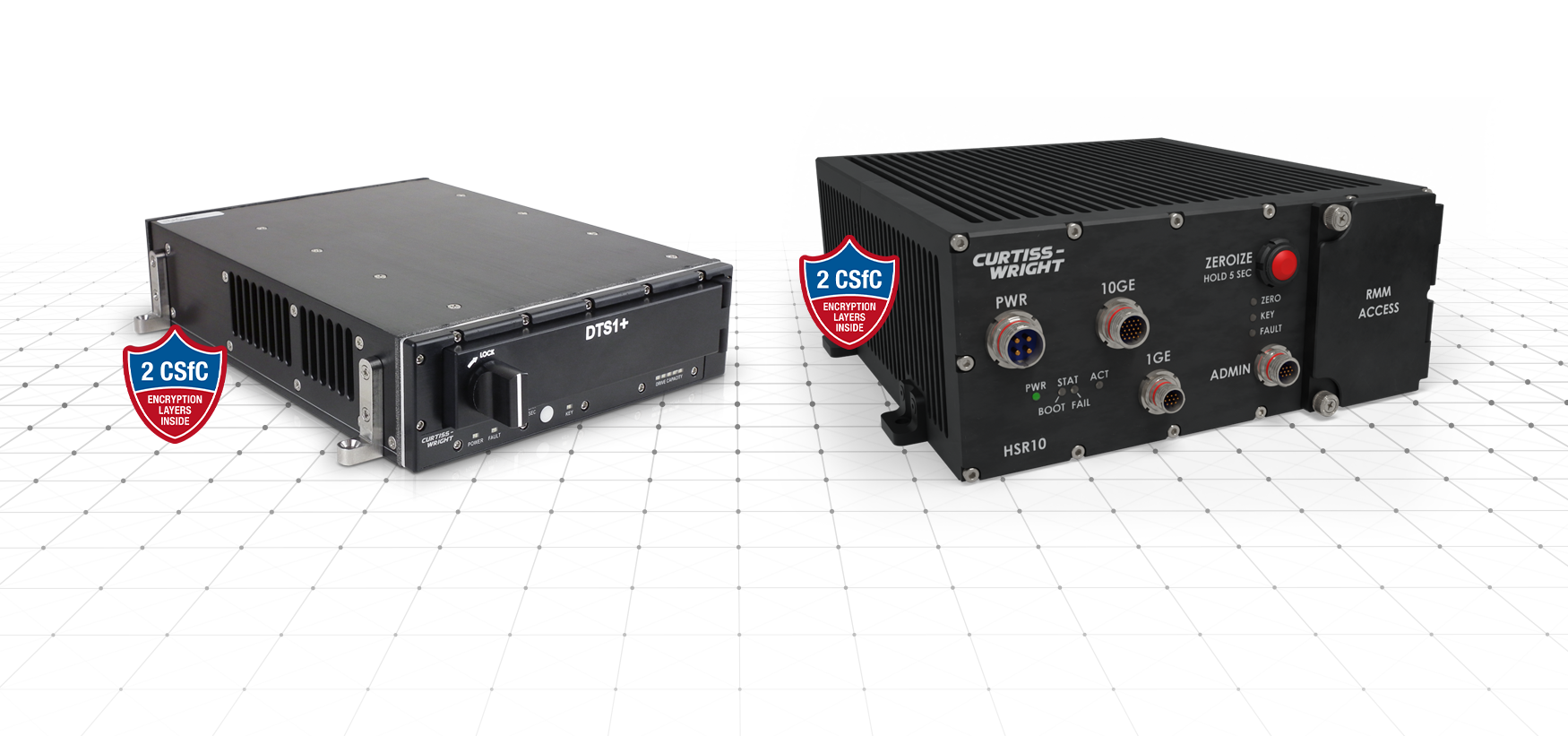
At Curtiss-Wright Defense Solutions, we’ve designed rugged network attached storage (NAS) systems that meet the NSA Capability Package requirements for CSfC DAR. Two proven examples are:
- DTS1+ NAS: Combines Hardware Full Drive Encryption (HWFDE) and Software Full Drive Encryption (SWFDE). Both are CSfC-approved and remain logically and physically independent.
- HSR10 NAS: A high-performance, rugged NAS solution with the same two-layer compliance, designed for aerospace and defense platforms that require extreme durability and mission assurance.
Both devices implement the inner and outer encryption layers precisely as CSfC DAR defines. Maintaining logical and physical independence between encryption components ensures compliance and long-term resilience in contested and classified environments.
Best Practices for Avoiding Layering Errors
Even experienced engineering teams sometimes stumble when mapping encryption layers. The following practices help ensure success:
- Start with the Capability Package. Ensure your design matches NSA’s approved component combinations and authentication order.
- Train your teams. Ensure every engineer and operator understands that layers are defined by authentication order, not data flow or encryption sequence.
- Use approved components. Avoid compliance challenges; only select solutions from the NSA’s CSfC Component List.
- Map authentication vs. data flow. Document each process separately to avoid confusion or incorrect assumptions.
- Validate early. Conduct compliance checks before system integration and deployment to avoid costly rework.
Curtiss-Wright’s Role in Mission-Ready Encryption
As a trusted defense technology partner, Curtiss-Wright provides:
- Proven, rugged CSfC-compliant storage solutions for harsh air, land, and sea environments
- Integration expertise to help programs meet compliance without schedule risk
- Ongoing support that adapts to evolving NSA guidance and emerging threats
We don’t just build hardware. We help customers protect their missions.
Compliance Is Mission Readiness
In a world where seconds matter and adversaries evolve quickly, compliance isn’t just a checklist; it’s mission assurance.
Getting the inner vs. outer encryption layers right is a seemingly minor detail, yet it has enormous consequences. Confusion can cause delays, increase costs, and risk exposure of sensitive mission data. Correct implementation ensures compliance, operational continuity, and mission readiness.
At Curtiss-Wright, we help defense programs get it right the first time with rugged, CSfC-approved NAS solutions. Download the white paper or contact Curtiss-Wright’s team to discuss your program’s needs.
FAQs
- What defines the inner and outer encryption layers in CSfC DAR?
The authentication order, not the encryption sequence. The outer layer is unlocked first, and the inner layer is unlocked second. - Why is distinguishing between inner and outer encryption layers important?
Incorrect implementation can lead to noncompliance, operational risk, and approval delays. - What are Red, Gray, and Black data in CSfC DAR?
Red = plaintext, Gray = once encrypted, Black = twice encrypted data. - When is a CSfC device classified or unclassified?
- Classified if the outer layer is unlocked
- Unclassified only when powered off or with no layers authenticated
- How does Curtiss-Wright ensure CSfC compliance?
By integrating NSA-approved encryption components into rugged NAS devices that follow the Capability Package requirements.

Angie Giles
Product Marketing Manager
A seasoned B2B marketing leader focused on translating complex technologies into impactful customer value.