Long before the widespread introduction of digital systems into aircraft in the 1970s, a dedicated wire or pipe connected everything in the cockpit. If a pilot needed to see the fuel level, they relied on a wire that ran directly from the fuel sensor to a gauge in the cockpit. Once aircraft became more complex, this point-to-point wiring became a nightmare.
The solution was to move away from thousands of individual wires to a single bus that multiple systems could use to send and receive digital data. This “avionics bus” reduces weight, simplifies maintenance, and integrates well with network-connected devices like glass cockpits, flight management and mission computers, and recorders.
Common Avionics Buses
There are many different avionics buses in use today. Some are widespread and in use across several platforms for decades. In contrast, others are limited to specific aircraft (such as ARINC 629 on the Boeing 777) or to specific systems (such as ARINC 717 for flight recorder data). The following are the four most commonly used avionics buses:
- ARINC 429
- MIL-STD-1553
- ARINC 664 pt7 (AFDX)
- CAN bus
ARINC 429: Widespread Civilian Aircraft Choice
ARINC 429 is the most common bus in civilian aviation and was introduced in the late 1970s (on the Boeing 737 and Airbus A320). Components connected to the buses are a transmitter (source), a receiver (sink), or a transmitter and receiver. All data is transmitted over a single twisted pair in one direction only and in a bipolar return-to-zero (RZ) format.
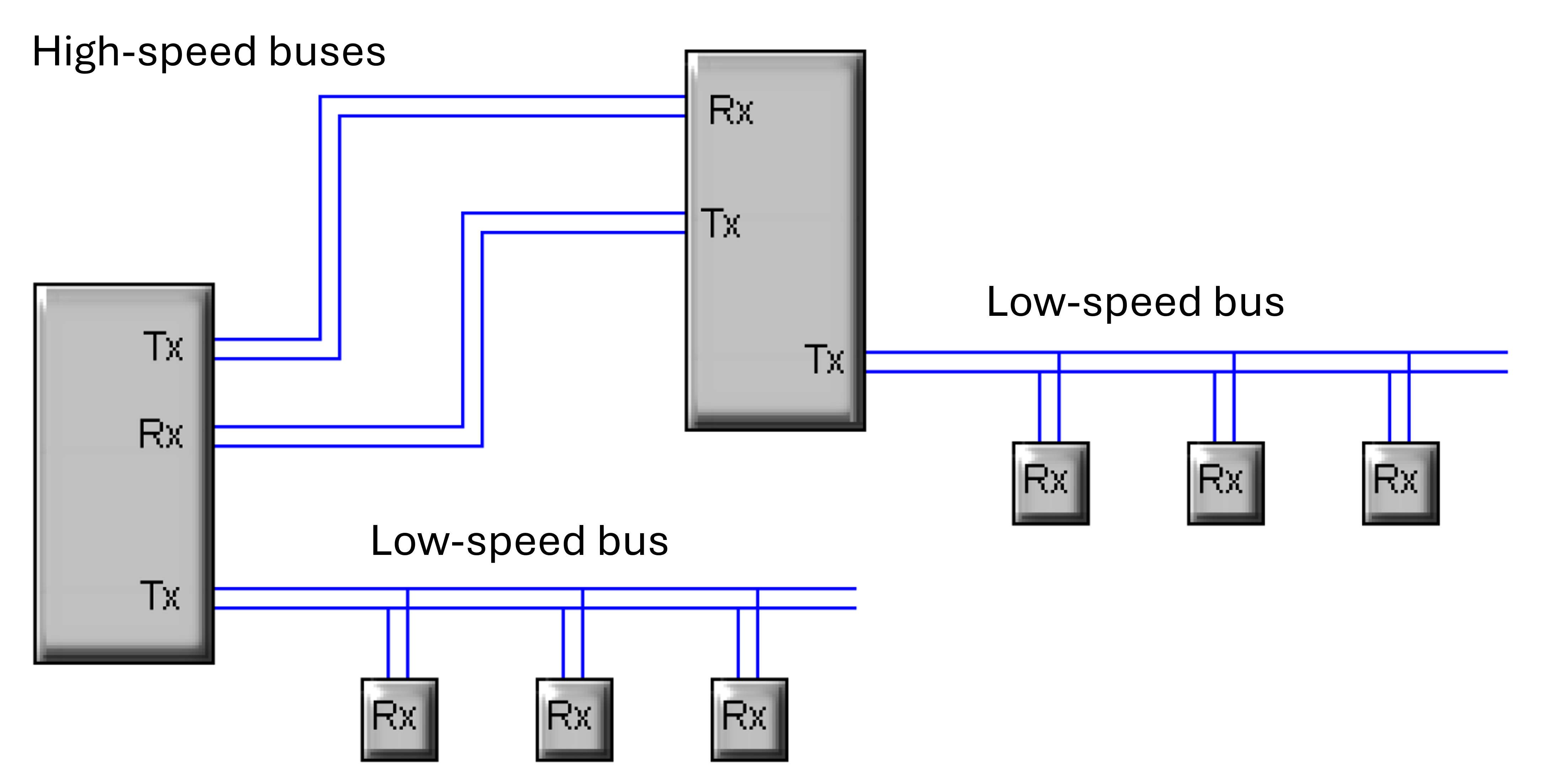
There are two bit-rates associated with ARINC-429. The high-speed bus is 100 kbps, and the low-speed bus is between 12 and 14.5 kbps. Only one data rate is allowed per bus.
| Where it’s used | Common, especially in commercial airliners and business jets. |
| Advantages | Extremely reliable, simple to implement, and easy to troubleshoot. Because data flows only one way, a faulty "talker" cannot easily crash the whole system. ARINC 429 components are widely available and relatively inexpensive. |
| Disadvantages | It can require a lot of wiring, since data only flows one way, and you need two separate sets of wires if two systems need to talk back and forth. It is also relatively slow by modern standards, compounding the wiring problem as more wires are required to meet modern avionics data needs. Variations in implementation can also lead to compatibility concerns. |
MIL-STD-1553: Common in Military and Space
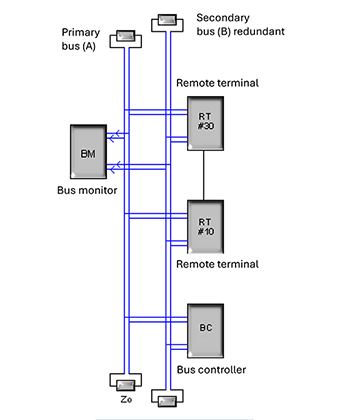
Introduced in the mid-1970s, MIL-STD-1553 Aircraft Internal Time Division Command/Response Multiplex Data Bus is a military standard (currently in revision B) that has become one of the key components used today for integrating avionics systems.
Unlike ARINC 429, it is a command/response system in which a bus controller commands up to 31 remote terminals (RT address 0 to 30) to transmit or receive. Data transfer is via a 1 Mbps, transformer-coupled, command-response bus using Bi-phase-level (Biφ-L) coding. The bus is dual-redundant in that only one bus is used at a time – the other is used if a remote terminal fails to respond.
| Where it’s used | Fighter jets (F-16, F-18), military helicopters (AH-64), and space platforms (James Webb space telescope). |
| Advantages | Highly "deterministic" (you know exactly when data will arrive) and very rugged. It features built-in "dual redundancy," meaning if one cable is damaged in combat, a backup cable takes over instantly. |
| Disadvantages | The bus controller is more complex to design and test than ARINC 429 and is a single point of failure. |
ARINC 664: Modern High-Speed Solution
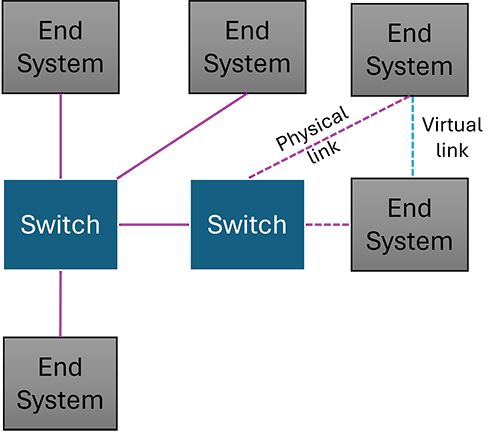
ARINC 664 Part 7 (or the Avionics Full-Duplex Switched Ethernet (AFDX) implementation developed and patented by Airbus for the A380) is a deterministic data network based on the widely used Ethernet standard. It was developed to meet the safety-critical needs of modern aircraft that began generating more data than existing avionics buses could accommodate.
AFDX consists of end systems (the avionics systems, like a GPS), switches, and links (the physical connections). Unlike traditional Ethernet, where the network routes a packet to a destination, AFDX uses pre-configured fixed paths called virtual links. A virtual link is similar to an ARINC 429 connection in that it is unidirectional and only links two systems.
| Where it’s used | Newer commercial aircraft like Airbus A350, Boeing 787 Airbus A380, ATR 72 (-600), AgustaWestland AW169, Comac ARJ21, and Learjet 85. |
| Advantages | High bandwidth (100 times faster than 1553). It uses standard Ethernet cables, which are low-cost, readily available, and reduce cable weight. It is scalable and flexible, allowing easier integration of new avionic subsystems. |
| Disadvantages | High complexity means sophisticated software and expensive switches are required to ensure data arrives on time (guaranteed delivery). |
CAN bus (ARINC 825): Widely Used for Subsystems and eVTOLs
Developed by Bosch as an automotive data bus in 1983, the controller area network (CAN) bus was developed as an automotive standard to lower the cost and complexity of wiring. It has since been adopted by many other sectors, including the aerospace industry, which uses the ARINC 825 standard, first published in 2007. CAN bus can be used as the backbone bus for an aircraft, but is often used as an ancillary bus to connect avionics subsystems (e.g., link sensors to avionics units).
The physical layer is a differential two-wire interface with wires for each bus. Bit encoding used is Non-Return to Zero (NRZ) encoding (with bit-stuffing). The use of NRZ encoding ensures compact messages with a minimum number of transitions and high resilience to external disturbance. Cable length depends on the data rate used (40 meters for 1 Mbps).
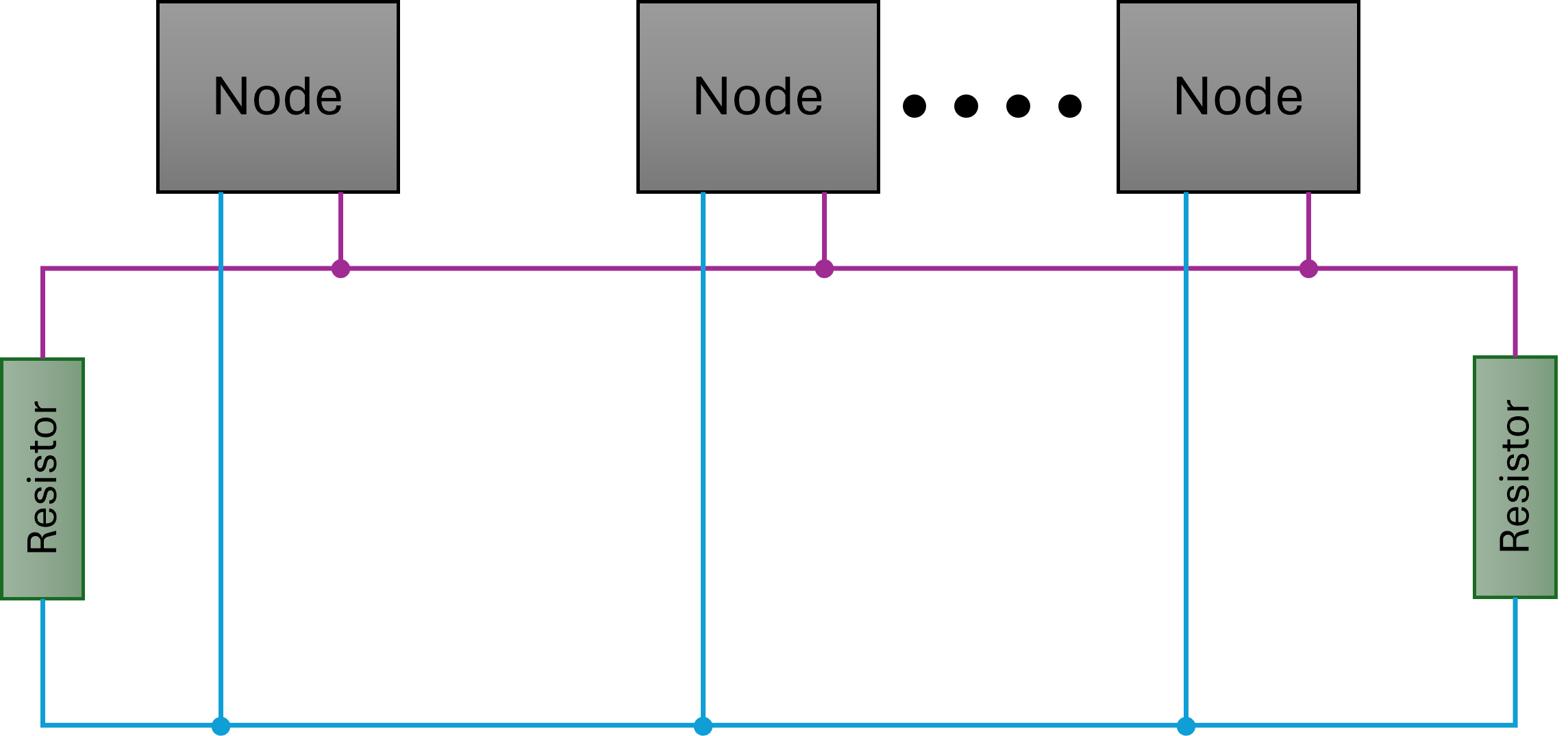
In 2012, CAN FD was released by Bosch to help meet higher data rate demands. An advantage of CAN FD for flight test programs is its support for up to 4x higher bit rates (to 4 Mbps) in the Data Field compared to the CAN bus 2.0 A/B Arbitration Field messages. This increases the payload from a maximum of 8 bytes to a maximum of 64 bytes using CAN FD, allowing higher data throughput than available with CAN bus devices.
| Where it’s used | Smaller aircraft, UAVs, EVTOL, and for ancillary systems on larger aircraft. |
| Advantages | Lightweight cables with simple installation. Easily scalable with low power requirements. Noise resistant and supports error checking and prioritized messaging for reliable and time-sensitive operation. |
| Disadvantages | Limited bandwidth as cable lengths and the number of connected devices increase. May need ‘ack’ on bus to operate properly. |
Summary Comparison Table
| Bus Type | Primary User | Speed | Complexity | Key Strength |
| ARINC 429 | Commercial | Low | Low | Simplicity and reliability |
| MIL-STD-1553 | Military | Medium | Medium | Combat robustness |
| AFDX | Modern Commercial | High | High | Massive data capacity |
| CAN Bus | General Aviation/UAV | Low | Low | Simplicity and low weight |
Acquiring Avionics Data for Flight Test
During flight test, the data acquisition systems are typically responsible for acquiring data from one or more avionics buses. There are two principal methods used: acquire everything (sometimes called snarfing) and selectively pick information off the bus (also known as parsing). Snarfing ensures you get as much information as possible, while parsing is more bandwidth efficient for applications like telemetry.
Modular data acquisition systems will generally support the most popular avionics buses with an existing catalogue of modules; some examples are here. Typically, manufacturers can accommodate new or more specialized buses with custom development if a COTS solution is not currently available.
Conclusions
Avionics buses form the communications backbone of any modern aircraft. This blog provides an overview of the four most used buses, along with their advantages and disadvantages. You can find more in-depth details on these buses, including architectures and data formatting, in the following technical note links:

Subscribe Today!
Subscribe to our blog and receive a monthly email that keeps you up-to-date with the latest news and insights from Curtiss-Wright.

Stephen Willis
Product Marketing Manager
Stephen Willis is the aerospace test and measurement Product Marketing Manager at Curtiss-Wright Defense Solutions. He has a degree in Electrical Engineering, a Masters in Philosophy for research in mathematical models and their market application for risk assessment, and a PG Dip in marketing and management. His current research interests include data acquisition, recording, and control systems and their applications in enabling a cost-effective route to gather large amounts of data. In particular, applications of interest include flight test, crash-protected recording, and structural/usage monitoring programs. He is the author of several academic papers and magazine articles.