
One of the most critical parts of flight testing is accurately measuring temperature. Whether we are monitoring the heat of a jet engine turbine, the cooling of a battery pack, or the skin temperature of a wing at high speeds, we need sensors that are reliable and accurate. In the world of flight test instrumentation (FTI), we primarily rely on two sensors: the thermocouple and the resistance temperature detector (RTD). This blog outlines the core characteristics and advantages of these sensors, focusing first on thermocouples, then RTDs, and finally comparing the two. More in-depth information on these sensors can be found in the thermocouple and RTD technical notes.
Thermocouples
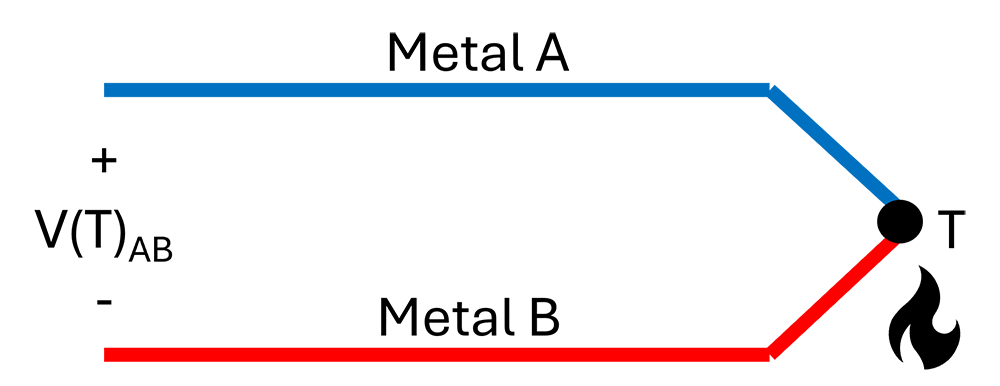
In 1821, Thomas Seebeck discovered that joining two different types of metal wires (let's call them Metal A and Metal B) at one end produces a tiny electrical voltage at that junction. This voltage changes with temperature, so by measuring that tiny voltage, we can tell how hot or cold the junction is.
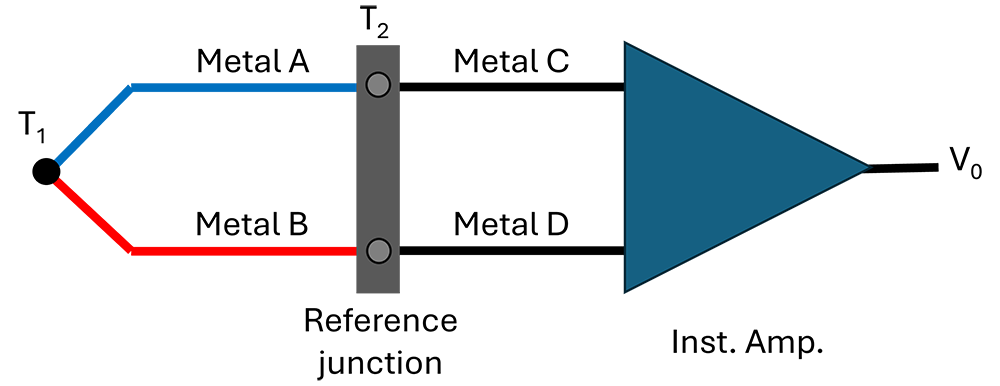
Making this sensor practical in the real world means connecting cables to it. Thanks to the “Law of Intermediate Metals”, these cables will not affect the measurement if all the wires at the connection points in the cable are at the same temperature. Electrically, the circuit is as shown in Figure 2, where metals C and D are the cables at equal temperature at the reference junction.
The voltage produced for a pair of metals is a non-linear function of the temperature of the junction. For this reason, the National Bureau of Standards (NBS) has compiled thermocouple tables listing the voltages produced by a loop for various combinations of metals. In Curtiss-Wright’s thermocouple acquisition modules, point tables mapping temperature to voltage and voltage to temperature are downloaded to the EEPROM to match the thermocouple type.
Types of Thermocouples
The American Institute for Standards (ANSI) has approved letters for some types of thermocouples. Table 1 displays the composition and range of some of the more popular types.
| Type | Composition | Range (ºC) | Range (mV) | Sensitivity at 0ºC (µV/ºC) |
| J | Iron Vs. Copper-Nickel | -210 +760 | -8.096 +42.922 | 50 |
| K | Nickel-Chromium Vs. Nickel-Aluminum | -270 +1370 | -6.458 +54.807 | 39 |
| E | Nickel-Chromium Vs. Copper-Nickel | -270 +1000 - | 9.835 +76.358 | 59 |
| T | Copper Vs. Copper-Nickel | -270 +400 | -6.258 +20.869 | 39 |
| S | Platinum Vs. Platinum-10% Rhodium | 0 +1760 | 0 18.612 | 5 |
Design Considerations
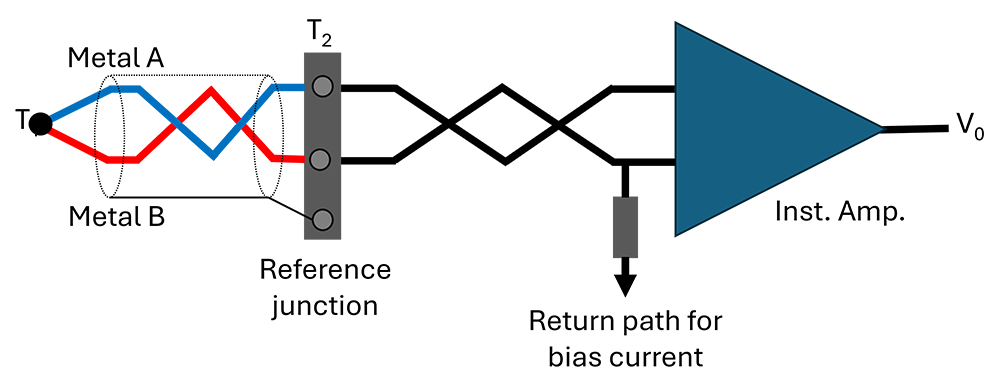
To reduce noise pickup and make it common-mode, thermocouple wires should be shielded and twisted. You should provide a current return path for bias currents from the instrumentation amplifier, as shown in Figure 3.
Thermocouple’s Advantages and Disadvantages
- Advantages: Thermocouples come in various shapes, are inexpensive, self-powered, rugged, and can measure extreme heat—up to 2,300 °C.
- Disadvantages: They aren't as accurate as other sensors, and they produce tiny voltages that can be easily "drowned out" by electrical noise from the aircraft, and require a reference junction (and the measurement of the junction temperature).
Resistance Temperature Detectors (RTD)
In 1871, Sir William Siemens proposed the resistance temperature detector (RTD), a thermometer that operates on the principle that the electrical resistance of a metal changes with temperature. By sending a small current through the sensor and measuring its resistance, we can calculate temperature with incredible precision. He chose to use platinum because it doesn’t oxidize at high temperatures and exhibits a relatively uniform change in resistance with temperature over a wide range.
An RTD probe is an assembly composed of a resistance element, a sheath, a lead wire, and a termination or connection.
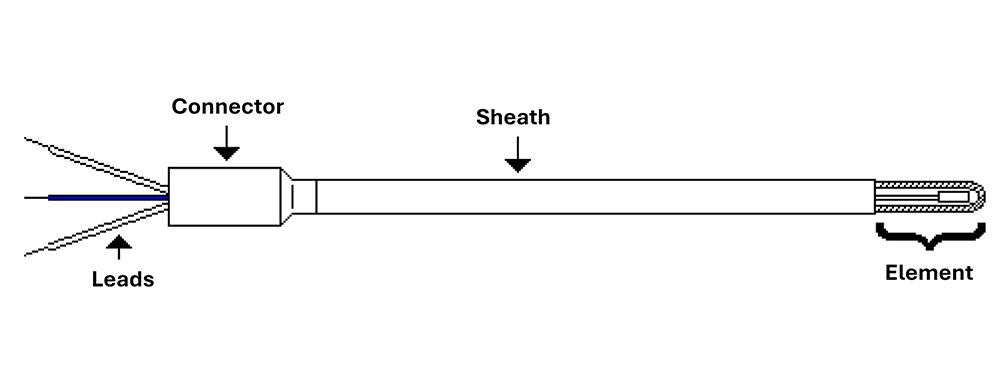
Resistance thermometers are used for a wide variety of industrial applications. The RTD can produce a high electrical output using simple resistance bridges, which can then be fed directly into recorders, temperature controllers, transmitters, or digital readouts.
Platinum is not the only viable metal, since all metals exhibit a positive change in resistance with increasing temperature. But platinum resistance wire has been generally acknowledged as the standard for accuracy and repeatability and is often the device of choice for temperatures between -259 °C and 631 °C. Table 2 compares the most popular RTD materials, showing their temperature ranges, resistivities, and temperature coefficients (how much a material's electrical resistivity changes with temperature).
| Material | Temp Range (°C) | Resistivity Ωm | ~Temp Coeff. %/°C at 25 °C |
| Platinum | -200 to +850 | 1.059 x 10⁻⁷ | 0.39 |
| Nickel | -80 to +320 | 6.842 x 10⁻⁸ | 0.67 |
| Copper | -200 to +260 | 1.664 x 10⁻⁸ | 0.38 |
RTDs come in 2-, 3-, and 4-wire probes. The most commonly used RTD is the 3-wire probe, which compensates for loop resistance by introducing a third wire, the reference wire, equal in length and size to the two wires connecting the RTD to the readout device. This third wire bypasses the RTD at its junction with one of the other two wires, allowing the readout device to automatically subtract the lead resistance from the circuit's overall resistance. A 4-wire RTD uses two reference wires for more accurate lead resistance measurement.
RTD’s Advantages and Disadvantages
- Advantages: They are extremely accurate and stable over a long time.
- Disadvantages: They are more fragile than thermocouples, more expensive, and have a limited practical temperature range.
Comparison of Thermocouples and Platinum RTDs
When choosing between a thermocouple and an RTD, the primary considerations are the environmental conditions at the measurement location and the required accuracy and stability of the reading.
RTDs are extremely precise at temperatures below 524 °C, can be recalibrated to ensure verifiable accuracy, are stable over the long term, follow a more linear curve than thermocouples, have high sensitivity, and provide accurate readings over narrow temperature spans.
But, for almost all other requirements in flight test applications, when a measurement to a couple of °C is good enough, thermocouples are preferable. They can withstand extreme bending and vibration, have a wider temperature range ( -162 °C to 2300 °C), and are less expensive.
There is no reason both sensors can't be used on an aircraft simultaneously. Modern data acquisition systems use a modular design, so an engineer can install the most suitable sensor for a system or surface without worrying about data acquisition support. They just need to select the appropriate modules to accommodate the number of channels, regardless of the combination of sensors used. The skill is understanding which sensor is best for gathering the required data. Table 3 presents a detailed summary of the advantages and disadvantages of RTDs and thermocouples to help with this decision. If you want more detailed information on these sensors, you can read the thermocouple and RTD technical notes.
| Factor | Thermocouple | Platinum RTD |
| Economics | Probe is cheaper. A 2-wire transistor can be used in the field if home run cables are lengthy, thereby keeping system cost down. | The probe is more expensive. System cost can be lower because RTDs use ordinary copper leads for extension wire. |
| Operations | Non-linear output signal. Small size-fast response. Higher temperature range. Point sensing. | Linear output signal. Limited size. Lower-use temperature range. No point sensing. |
| Reliability | More reliable with vibrations and at high pressures (in excess of 10,000 PSIG) and high temperatures (in excess of 4000 °F). | Not as reliable to shocks and vibrations, and poor stability in high temperatures. |
| Maintenance | More rugged. Not as vulnerable to contamination. | Less rugged. More vulnerable to contamination. |
| Sensor accuracy | ±2 °F or 3/8 of 1% of reading. | More accurate, ±0.1% with compensating loop. |
| General overall system accuracy | Approx. ±0.75% of the reading measured temperature. | Approx. ±0.5% of the measured temperature. |
| Installation methods | Equal. | Equal with one additional wire. |
| Wiring methods | Two-wire, thermocouple material. | Three-wire minimum, copper wire. |
| Terminations | Same. | Same. |
| Monitoring equipment | Readily available. Monitors sensor output only and compensates for cold junction temperature. Reads sensor output only (for temperature). | Readily available. Interprets a change in lead wire resistance as a temperature change when 3- or 4-wire systems are not used. |

Subscribe Today!
Subscribe to our blog and receive a monthly email that keeps you up-to-date with the latest news and insights from Curtiss-Wright.

Stephen Willis
Product Marketing Manager
Stephen Willis is the aerospace test and measurement Product Marketing Manager at Curtiss-Wright Defense Solutions. He has a degree in Electrical Engineering, a Masters in Philosophy for research in mathematical models and their market application for risk assessment, and a PG Dip in marketing and management. His current research interests include data acquisition, recording, and control systems and their applications in enabling a cost-effective route to gather large amounts of data. In particular, applications of interest include flight test, crash-protected recording, and structural/usage monitoring programs. He is the author of several academic papers and magazine articles.