Modern avionics programs rarely stand still. As mission requirements evolve, engineers are often asked to add new capabilities without redesigning the entire system. A digital cockpit requires additional display interfaces. A mission computer needs MIL-STD-1553 connectivity. A sensor-processing application calls for FPGA acceleration. Every aerospace program has its own unique combination of processing, networking, storage, and I/O. Meeting these requirements has traditionally forced engineers into a difficult compromise: select a standard processor card and sacrifice functionality, or develop a custom hardware design from scratch.
Neither option is ideal. Custom hardware development introduces steep costs, schedule pressure, integration complexity, and certification risks. Even seemingly small changes can require additional testing, documentation, and verification effort.
Aerospace engineers face this pressure every day. Modern avionics systems demand more processing power and specialized connectivity than ever before, yet programs must simultaneously reduce development risk and accelerate time-to-market.
The computing architecture at the heart of these systems must deliver high-end performance—without forcing the risk, cost, and complexity of a custom-designed processor board.
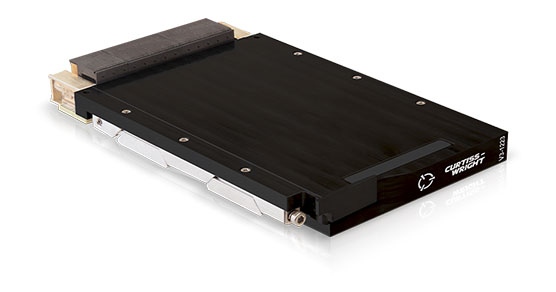
The new Curtiss-Wright V3-1223 avionics computing processor ends this tradeoff, instantly transforming safety-critical systems into high-performance data hubs.
How Can Programs Avoid Custom Processor Designs?
The V3-1223 is a SOSA® aligned, OpenVPX rugged module that builds on the proven architecture of its predecessor, the V3-1222. While the previous generation provides strong computing performance, it offers limited flexibility for adding new interfaces or accelerators.
The V3-1223 changes the equation by introducing an XMC expansion site. This site allows engineers to seamlessly add application-specific functionality without redesigning the processor card itself. Whether an application requires avionics interfaces, video capture, FPGA acceleration, storage, or other specialized functionality, engineers can add those capabilities through an XMC module while maintaining a common processor architecture.
Instead of developing a custom processor card for every distinct application, programs can start with a single, proven DAL A-certifiable processing platform and quickly configure it to meet their exact mission needs.
The benefits are immediate:
- Drastically reduced hardware development and engineering overhead
- Lower-risk safety certification by using a consistent, baseline hardware platform
- Greater life-cycle flexibility, allowing systems to adapt quickly as future mission requirements evolve

Built for Safety-Critical Mission Success
Flexibility is only part of the equation. Aerospace and defense systems must also meet stringent safety requirements. The V3-1223 addresses both sides of this equation by delivering a massive performance leap alongside robust certification support.
Powered by the 13th Gen Intel® Core™ i7 processor and integrated Intel® Iris® Xe graphics, the V3-1223 delivers approximately 40% higher CPU performance than previous generations and competing solutions.
To help system safety engineers integrate the board into flight-critical systems with minimal program risk, the V3-1223 offers:
- DAL A & DO-254 Support: Backed by a comprehensive suite of certification artifacts developed to the highest Design Assurance Levels (DAL)
- Advanced Monitoring: Built-in continuous system health monitoring with a dedicated CardFail signal to maximize reliability and ensure pilots never go dark when it matters most
- RTOS Ecosystem: Seamless integration with leading Real-Time Operating System (RTOS) partners, including DDC-I, Green Hills, Lynx/Core AVI, Sysgo, and Wind River
Versatile Applications Across the Aircraft
The V3-1223 is designed for applications where performance, modularity, and strict safety compliance must coexist. It serves as a foundational component across several cutting-edge applications:
- Commercial & Military Aviation: Powers digital cockpit systems, Primary Flight Displays (PFD), Head-Up Displays (HUD), and Multifunction Displays (MFD)
- Next-Gen Defense Platforms: Drives fighter jet systems, surveillance platforms, C5ISR, and radar/sensor fusion applications
- Advanced Air Mobility (AAM): Ideal for eVTOL, military drones, and autonomous aircraft platforms that require lightweight, highly certifiable computing power.
Whether supporting a new aircraft design or modernizing an existing platform, the V3-1223 can be tailored to your exact configuration.
What Does This Mean for the Future of Avionics Computing?
For years, avionics computing platforms were largely judged by processing performance: faster processors, more memory, better graphics. Those capabilities remain important. But the most successful future platforms won't simply deliver more computing power. They'll provide the flexibility to support a wide range of avionics interfaces, sensors, storage options, and processing requirements without forcing custom processor designs.
The Curtiss-Wright V3-1223 represents this broader evolution—moving past performance alone to deliver a balanced, COTS-based, and SOSA-aligned architecture that harmonizes massive processing power, modular expansion, and low-risk safety certification.
To learn more about how the V3-1223 can accelerate your safety-critical program's time-to-deployment, read the full technical specifications or contact a Curtiss-Wright expert today.
Learn More
- Explore the V3-1223
- Download the V3-1223 datasheet
- Connect with a Curtiss-Wright expert to discuss your application
Key Takeaways
Modern aerospace programs require more than processing performance. Engineers increasingly need computing platforms that can support application-specific interfaces, sensors, storage, and processing requirements while minimizing development and certification risk.
Custom hardware development can add significant cost, schedule pressure, and integration complexity. Even seemingly small design changes can require additional testing, documentation, and verification effort.
Flexible architectures help reduce the need for custom processor designs. By enabling program-specific functionality through standardized expansion options, engineers can tailor systems to their requirements while maintaining a common computing foundation.
The V3-1223 combines a proven safety-certifiable processor architecture with XMC expansion flexibility. Engineers can add specialized functionality such as avionics interfaces, video capture, FPGA acceleration, or storage without redesigning the processor card itself.
Configuration flexibility helps simplify integration and reduce program risk. By allowing a single processor platform to support a wide range of application requirements, the V3-1223 can help accelerate development and streamline deployment across aerospace and defense programs.

Subscribe Today!
Subscribe to our blog and receive a monthly email that keeps you up-to-date with the latest news and insights from Curtiss-Wright.
FAQs
- How does the V3-1223 reduce development and certification risk?
By allowing engineers to add application-specific functionality through an XMC expansion module rather than developing a custom processor design. This helps reduce hardware development effort, simplify integration, and minimize testing and verification for new hardware designs. - Why is XMC expansion important for aerospace programs?
Different aircraft programs often require different combinations of avionics interfaces, storage, video capture, and processing acceleration. The V3-1223's XMC expansion site allows engineers to tailor the platform to their specific application requirements while maintaining a common processor architecture. - How can aerospace programs avoid custom processor designs?
One of the most effective approaches is to use modular computing architectures that support application-specific functionality through standardized expansion modules. Rather than developing a unique processor card for every program, engineers can start with a proven processing platform and add the interfaces, storage, video capture, FPGA acceleration, or other capabilities their application requires. This can reduce development effort, simplify integration, and lower program risk. - What is an XMC module?
An XMC (Switched Mezzanine Card) module is a small expansion card that adds functionality to a processor board. Depending on the application, an XMC module can provide additional avionics interfaces, FPGA acceleration, video capture, storage, networking, or specialized I/O. The V3-1223 includes an XMC expansion site, allowing engineers to add new capabilities without redesigning the processor card itself. - How do I reduce certification risk in aerospace programs?
Reducing certification risk starts with selecting hardware that supports aerospace certification objectives and using proven architectures whenever possible. Modular designs can also help by allowing new functionality to be added without requiring a complete hardware redesign. This can reduce the amount of testing, documentation, and requalification needed as systems evolve. - What is DAL A?
DAL A, or Design Assurance Level A, is the highest level of safety assurance defined by aerospace certification standards such as DO-254 and DO-178C. It applies to systems whose failure could have catastrophic consequences for an aircraft. Products designed to support DAL A objectives can help simplify certification activities for safety-critical applications such as flight displays, flight control systems, and other functions where failure could have catastrophic consequences. - What is a safety-certifiable processor?
Unlike commercial computing products, safety-certifiable processors, like the V3-1222 and V3-1223, are designed to support the rigorous development, verification, traceability, and documentation processes required for aerospace certification. These processors are commonly used in applications such as flight displays, flight control computers, mission systems, and other environments where reliability and predictable operation are critical. - What is the difference between the V3-1222 and the V3-1223?
Both products provide high-performance 13th Gen Intel Core i7 processing and support DAL A certification objectives. The V3-1223 adds an XMC expansion site, allowing engineers to incorporate application-specific functionality such as avionics interfaces, video capture, FPGA acceleration, storage, and other specialized I/O without redesigning the processor card.

Aaron Frank
Senior Director, C5ISR Product Management
Aaron Frank joined Curtiss-Wright in January 2010. As the Sr Director of the Product Management team, he is responsible for a wide range of COTS products utilizing advanced processing, video graphics/GPU and network switching technologies in many industry-standard module formats (VME, VPX, etc.). His focus includes product development and marketing strategies, technology roadmaps, and being a subject matter expert to the sales team and with customers. Aaron has a Bachelor of Science in Electrical Engineering degree from the University of Waterloo.
