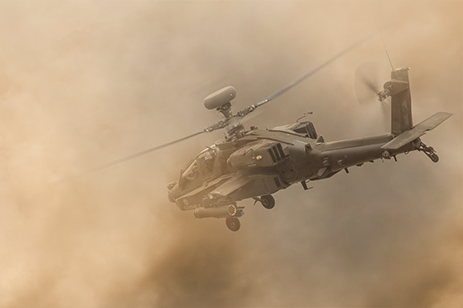
A leading U.S. aerospace integrator supporting Army aviation set out to solve one of the most dangerous challenges in rotary‑wing operations: landing safely when pilots can’t see. Their aircraft support missions where dust, fog, smoke, and darkness are constant threats. To keep crews safe and maintain operational tempo, they needed a next‑generation Degraded Visual Environment Mitigation (DVE‑M) system. One that fused sensor data in real‑time, delivered ultra‑low‑latency graphics, and could be fielded quickly without the cost and delay of custom hardware.
The Challenge
Degraded visual environments routinely put pilots at risk. When visibility collapses, situational awareness disappears, and even routine landings become hazardous. The Army’s DVE-M initiative aims to turn this vulnerability into an advantage by giving pilots fused, high-clarity imagery even in zero-visibility conditions.
But building such a system is notoriously difficult. Custom hardware drives long development cycles, high program costs, and lifecycle uncertainty. If the integrator couldn’t solve these challenges quickly, they risked missing critical test windows and losing the opportunity to compete for production aircraft.


