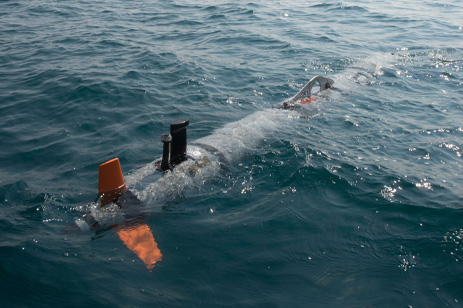
A large military shipbuilding company looked to deliver the U.S. Navy a modernized small unmanned underwater vehicle (SUUV) with expanded capabilities. The next-generation platform would need to support distributed maritime operations by executing critical underwater missions such as mine countermeasures, intelligence gathering, and reconnaissance in contested waters. To ensure the success of these missions, the modular, man-portable design required data storage capable of protecting sensitive mission data in the harshest conditions.
The operational demands placed on the SUUV created a unique set of data management challenges. The vehicle needed to capture, store, and protect large volumes of classified mission data in real time, all within a compact, unmanned platform’s size, weight, and power (SWaP) constraints. The solution had to meet rigorous data-at-rest (DAR) security requirements from the U.S. National Security Agency (NSA), ensuring mission data remained protected during operation and in the event of loss or capture by adversaries. Adding to the complexity, the storage system had to align with the Department of Defense’s Modular Open Systems Approach (MOSA) mandate.
