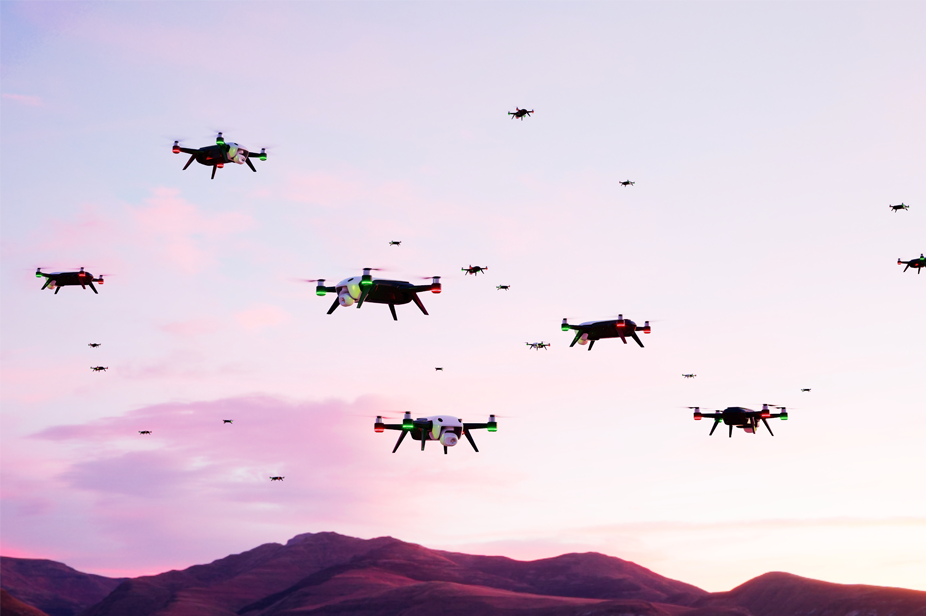
The military advantage of drone swarms – massed intelligence, surveillance, and reconnaissance (ISR), coordinated electronic warfare, and saturation attacks – is undeniable. But the inability of these swarms to communicate with existing tactical data link (TDL) networks is a challenge that can undermine their operational utility.
This interoperability gap means swarms are invisible on primary tactical displays, forcing the creation of Restricted Operating Zones (ROZs), which limit friendly maneuverability.
This paper discusses how TCG HUNTR®, a field-proven application-layer gateway, solves the problem by acting as a universal translator between swarm networks and tactical data links. It delivers immediate situational awareness without segmenting the battlespace or requiring platform modifications.
The Drone Swarm Communications Problem
Drone swarms achieve coherent behavior through internal mesh networking and protocols such as MAVLink, which handle intra-swarm coordination, collision avoidance, and distributed task assignment. These protocols solve the first layer challenge of getting multiple unmanned platforms to function as a cohesive unit. However, they operate within a closed ecosystem, creating a second, more complex problem: interoperability with the broader joint force.
Log in to download the white paper.

Peter Ellis
Principal Engineer
Peter Ellis is a Principal Engineer for Curtiss-Wright Corporation. He has built a career as a tactical data link (TDL) subject matter expert with more than 23 years of experience writing software and working with TDL equipment and systems for the tactical communications group (TCG) based in Tewksbury, MA. Peter specializes in applying known or existing technologies using new and innovative ideas and solutions to overcome the toughest challenges faced by today’s warfighter, all while maintaining an enthusiastic and positive attitude. He is motivated by working with smart innovative people to create powerful, high quality, and easy-to-use software and seeing the positive impact on users, even in challenging battlefield environments. Outside of work, Peter enjoys mountain biking and fishing in his hometown of Andover and spending time with his wife and two young children.
