As defense systems become more distributed and software-defined, the challenge is no longer simply moving data, it is ensuring critical data arrives exactly when it’s needed. This is something Ethernet was never originally designed to do. In traditional Ethernet, critical, time-sensitive data—such as targeting information, sensor feeds, or control signals—travels alongside routine network traffic without guaranteed delivery timing. Quality of Service provisions can move the data to the front of every queue, but that still does not guarantee time-bound accuracy. The data eventually arrives, but there’s no assurance of when it will arrive. And in modern defense systems, timing matters.
The solution is called Deterministic Ethernet, but to understand what this means, let’s look at how a digital backbone operates in a crisis.
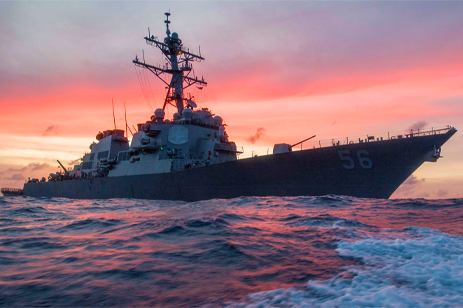
Imagine an unarmed military supply ship carrying disaster-relief food and medicine through a tense coastal region. These massive vessels rely entirely on passive electronic defenses like launching decoys or initiating automated rudder commands to escape a threat. However, inside this ship, a single network handles everything from critical missile warning sensors to the routine inventory system scanning barcodes down in the cargo hold. Under traditional Ethernet, all data is processed on a first-come, first-served basis.
Imagine the crew is uploading a massive inventory file at the exact millisecond that a coastal anti-ship missile locks onto the ship. The life-saving decoy command gets trapped in a digital traffic jam behind the barcode data. Delayed by just a fraction of a second, the decoys launch too late, and the missile strikes the vessel.
The key to changing this outcome is upgrading the digital backbone with Time-Sensitive Networking (TSN). It turns a chaotic network into a highly orchestrated, deterministic system.
First, TSN aligns every device on the ship to a single, microsecond-accurate master clock, allowing the network to schedule guaranteed communication windows for critical systems. The moment the emergency hits the network, TSN instantly stops the routine barcode file mid-transmission to let the priority alert fly past. To guarantee message arrival, TSN duplicates the decoy command and sends it down multiple independent physical paths simultaneously, ensuring that even if an initial blast cuts a network wire, the command still reaches its destination without a single millisecond of lag.
The real-world outcome of this architecture is predictable, real-time threat response. The decoys shoot into the air instantly, creating a fake radar reflection that tricks the missile into splashing harmlessly into the empty ocean. A millisecond later, the network automatically finishes the inventory upload without the crew even realizing a disruption occurred. This is just one scenario demonstrating how TSN works in perfect harmony to ensure that routine computing tasks can never accidentally blind the critical systems keeping a mission and its team safe.
What is Time-Sensitive Networking (TSN)?
Time-Sensitive Networking (TSN) is a collection of new capabilities built into the IEEE Ethernet standards, designed to bring deterministic, time-aware communications over Ethernet networks.
It transforms standard Ethernet from a “best-effort” network into a highly orchestrated, time-assured delivery system. In a standard network, data is treated like standard mail: packets are sent out, and while they will likely arrive at their destination, there is no guarantee exactly when they will get there. TSN changes the rules by guaranteeing that critical data arrives with microsecond-level predictability, every single time.
To achieve this level of deterministic control, a network must deploy an interconnected ecosystem of core TSN capabilities:
- Time Synchronization (IEEE 802.1AS): This is the foundation of the entire system. It acts as a single, ultra-precise master clock that synchronizes every single device across the platform—from the radar sensors on the bridge to the barcode scanners in the cargo hold. Because every node shares the exact same microsecond, the network can orchestrate traffic with flawless timing.
- Credit Based Shaping (IEEE Qav), Time-Aware Shaper (IEEE 802.1Qbv): Think of this as a strictly enforced schedule for your data lanes. It creates dedicated, repeating time slots reserved exclusively for mission-critical traffic. When a high-priority steering command needs to travel across the ship, the Time-Aware Shaper ensures the lane is completely empty and waiting.
- Frame Preemption (IEEE 802.1Qbu): If a massive logistics or inventory file is already moving down the wire when an incoming threat is detected, the network cannot afford to wait for that file to finish uploading. Frame Preemption instantly slices the routine file in half mid-transmission, lets the emergency countermeasure command fly past with zero delay, and then seamlessly stitches the inventory file back together.
- Per-Stream Filtering and Policing (PSFP) (IEEE 802.1Qci): This feature acts as an automated security guard at the network switch. If a damaged piece of cargo hardware or a rogue system tries to flood the network with erroneous data, PSFP catches it instantly and blocks it, preventing a localized glitch from blinding the ship's defense systems.
- Frame Replication and Elimination for Reliability (FRER) (IEEE 802.1CB): In a tactical environment, physical survivability is paramount. FRER automatically duplicates critical commands and sends them down multiple completely independent physical cables simultaneously. If an explosion or structural failure cuts one network line, the identical command still arrives via the backup path without losing a single microsecond to troubleshooting or failover lag.
- Fault Tolerant Timing (FTT) (IEEE 802.1ASed): In a TSN network, clock synchronization is the backbone for time-aligned traffic. FTT permits the use of multiple simultaneous timing domains within a single network, supporting different timing domains in subsystems such as sensors vs. mission vs. flight controls.
Legacy deterministic networking technologies such as AFDX or Time-Triggered Ethernet (TTE) provide deterministic communications, but often at higher cost and with less flexibility. TSN delivers the same deterministic behavior using standard Ethernet while reducing cost and greater flexibility, with much more universal adoption.
As aerospace and defense systems evolve toward distributed processing, AI-enabled architectures, and software-defined platforms, TSN is rapidly emerging as a foundational technology for next-generation digital backbones.
Why Isn’t a TSN Switch Alone Enough?
One of the biggest misconceptions about TSN is that deploying a TSN-capable switch automatically creates a predictable system. It doesn’t.
True end-to-end determinism requires:
- TSN-aware network infrastructure
- TSN-capable compute endpoints
- Shared timing synchronization
- Coordinated traffic behavior across the entire system
“TSN only works when all parts of the network chain participate in determinism,” explains Aaron Frank, Senior Director of C5ISR Modular Solutions at Curtiss-Wright. “The network and the compute endpoints must operate together as part of the same synchronized architecture.”
This is where many TSN deployments become difficult. Some suppliers provide TSN features on computing nodes, and other suppliers provide TSN features on network switches. Integrators are then forced to figure out how to make all the different pieces work together.
By offering a suite of TSN-enabled building blocks that are tested and assured to work together, Curtiss-Wright is simplifying the adoption of TSN.
How Does the VPX3-656 Complete Curtiss-Wright’s TSN Portfolio?
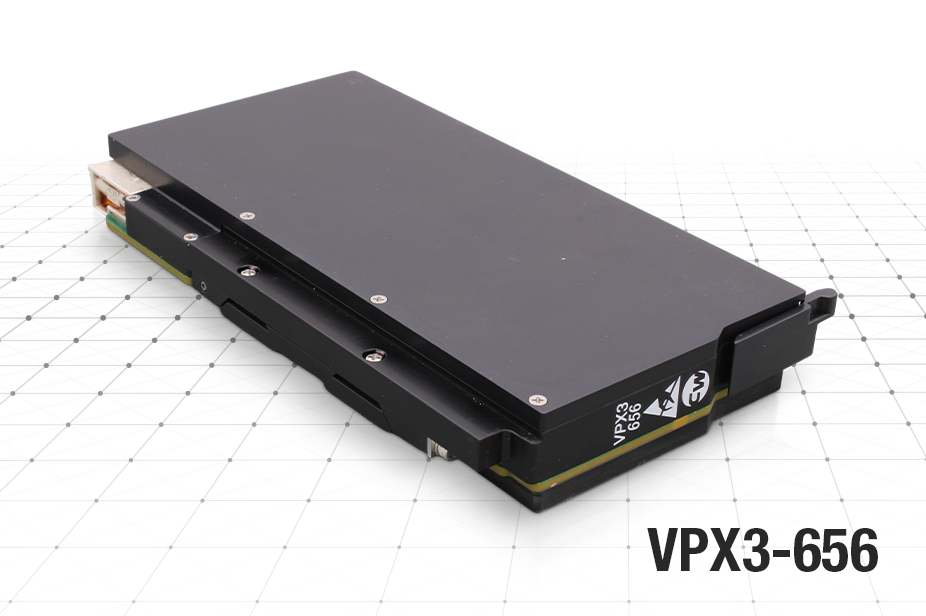
Curtiss-Wright is introducing the new VPX3-656, a SOSA® aligned 10G Ethernet switch specifically designed to support deterministic TSN communications in rugged aerospace and defense environments.
The VPX3-656 acts as the network “brain” of a TSN system by:
- Scheduling deterministic traffic
- Synchronizing system timing
- Supporting both TSN and standard Ethernet traffic simultaneously
The switch supports:
- Feature-rich Layer 2 switching and Layer 3 routing
- Full suite of IEEE 802.1DP TSN Aerospace Profile features
- Integrated PTP Grandmaster timing
- 1GbE and 10GbE network interfaces
- Copper and optical Ethernet connectivity
- Convenient rear VPX optical interfaces
But the larger story is that the VPX3-656 completes Curtiss-Wright’s broader TSN ecosystem.
What Makes Curtiss-Wright’s TSN Approach Different?
Some TSN suppliers focus only on the network switch. Other TSN suppliers offer compute modules with various levels of TSN support. Each supplier picks different mixes of TSN capabilities and leaves the challenge of getting TSN to work to the systems integrator.
Curtiss-Wright delivers a full end-to-end TSN capability, with:
- 3U VPX SOSA-aligned modules designed to meet the full feature set of the IEEE 802.1DP TSN Aerospace Profile
- A range of computing modules with 1G and 10G TSN endpoints
- A powerful 1G/10G TSN switch supporting both TSN as well as non-TSN Ethernet traffic
The Curtiss-Wright growing family of TSN-enabled processing solutions include:
- VPX3-656 — 1G/10G TSN Ethernet switch
- VPX3-1262 — Fabric100™-enabled processor for high-performance mission processing, supporting 1G and 10G TSN-enabled Ethernet ports
- VPX3/V3-1222 — DAL-A certifiable processing with four TSN-enabled 1G Ethernet ports
- VPX3/V3-1223 — DAL-A certifiable processing with XMC expansion and a TSN-enabled 1G Ethernet port
Together, these products form a synchronized, end-to-end TSN portfolio designed to simplify deployment of deterministic Ethernet systems.
“Customers don’t just need an affordable TSN switch—they need TSN building blocks that work well together” says Frank. “The VPX3-656 completes that portfolio by combining a TSN deterministic network backbone with TSN-enabled compute engines that work together seamlessly.”

Why Choose?
The VPX3-656 supports both conventional Ethernet and TSN, enabling programs to deploy an affordable networking solution today and seamlessly migrate to deterministic communications as requirements evolve. The result is a lower-risk, future-ready path to TSN without sacrificing performance, interoperability, or budget.
How Does an End-to-End TSN System Actually Work?
Inside a VPX-based system:
- The VPX3-656 controls timing, synchronization, and traffic flow
- TSN-enabled processing modules VPX3/V3-1222, VPX3/V3-1223, and VPX3-1262 generate and process time-critical data
All nodes cooperate with:
- A shared system time reference
- Scheduled communications windows
- Predictable deterministic traffic behavior
The result is synchronized coordination across:
- Sensor fusion systems
- AI processing nodes
- Mission computing
- Autonomous functions
- Real-time control systems
“Deterministic networking becomes increasingly important as systems evolve toward distributed processing and AI-enabled architectures,” says Frank. “TSN allows programs to coordinate complex systems using standards-based Ethernet while reducing the complexity associated with legacy deterministic networks.”
Why Does the IEEE 802.1DP Aerospace Profile Matter?
The VPX3-656 aligns with the IEEE 802.1DP TSN Aerospace Profile, a standards framework designed specifically for aerospace and defense TSN implementations.
This matters because TSN itself includes many optional standards and implementation approaches. Without a common profile, interoperability between vendors can become difficult.
The Aerospace Profile helps standardize:
- Timing behavior
- Synchronization methods
- Traffic scheduling approaches
- Deterministic communications behavior
This helps reduce:
- Integration risk
- Validation complexity
- Multi-vendor interoperability issues
How Does TSN Support Open Standards and Digital Backbone Modernization?
As defense platforms modernize toward the Sensor Open Systems Architecture™ (SOSA®) and Modular Open Systems Approach (MOSA), many programs are replacing dedicated point-to-point interfaces with Ethernet-based digital backbones.
TSN helps enable this transition by supporting:
- Deterministic communications
- Distributed compute architectures
- Consolidated networking
- Reduced wiring complexity
- Coexistence of TSN and non-TSN traffic
This makes TSN especially attractive for:
- Ground vehicle modernization
- Aircraft mission systems
- AI-enabled edge processing
- Sensor fusion architectures
- ISR platforms
- Autonomy and coordinated operations
Programs want a practical migration path toward deterministic Ethernet without replacing entire systems overnight. TSN and the VPX3-656 enable that evolution while still supporting existing architectures—all with one of the lowest-cost TSN switch solutions available for aerospace and defense applications.
Modern defense systems cannot afford to let a traffic jam of everyday logistics data dictate a platform’s response time in a crisis. The reality is that true time certain predictability requires an entire interconnected network ecosystem working with clockwork precision. By pairing a high-bandwidth, defense-grade backbone switch like the VPX3-656 with TSN-enabled compute endpoints, system integrators can finally bridge the gap between open-standard flexibility and mission-critical survivability, ensuring critical information gets priority when timing matters most.
Learn More
Explore the new VPX-656
Download the VPX3-656 datasheet
Connect with a Curtiss-Wright expert to discuss how TSN can help simplify deterministic Ethernet integration for your specific application
Key Takeaways
- Traditional Ethernet cannot guarantee deterministic timing for mission-critical data
- TSN adds synchronized, time-aware behavior to standard Ethernet networks
- True deterministic networking requires both TSN switching and TSN-capable endpoints
- The VPX3-656 completes Curtiss-Wright’s TSN architecture by adding deterministic switching and timing control
- The IEEE 802.1DP Aerospace Profile helps improve interoperability and reduce integration risk
- TSN supports next-generation MOSA digital backbone modernization strategies
Frequently Asked Questions
- What problem does TSN solve?
TSN solves the problem of unpredictable Ethernet timing by ensuring critical data arrives within guaranteed time windows. - How is TSN different from standard Ethernet?
Standard Ethernet is “best effort,” meaning traffic-timing cannot be guaranteed. TSN adds synchronization and scheduled traffic behavior to make Ethernet deterministic. - Why does deterministic networking matter in defense systems?
Many modern defense applications—including sensor fusion, autonomy, AI, and mission computing—depend on tightly synchronized real-time data exchange. - What makes the VPX3-656 different from other TSN switches?
The VPX3-656 is the first SOSA® aligned TSN Ethernet switch designed to work with Curtiss-Wright’s TSN-enabled compute portfolio. - What Curtiss-Wright products support TSN?
Curtiss-Wright’s TSN portfolio includes: - What is the IEEE 802.1DP Aerospace Profile?
The Aerospace Profile defines how TSN should be implemented in aerospace and defense systems to improve interoperability and predictable deterministic behavior. - Can TSN coexist with existing Ethernet traffic?
Yes. TSN networks can support both deterministic TSN traffic and standard Ethernet traffic simultaneously, enabling the gradual modernization of existing platforms.

Subscribe Today!
Subscribe to our blog and receive a monthly email that keeps you up-to-date with the latest news and insights from Curtiss-Wright.

Allison Freedman
Product Marketing Manager
Allison is the C5ISR Modular Solutions Product Marketing Manager at Curtiss-Wright Defense Solutions. She specializes in rugged embedded computing, networking, and mission systems for aerospace and defense platforms. She has more than two decades of experience in technology marketing and working with engineers and product managers to communicate the technologies shaping next-generation defense platforms. She is passionate about supporting those in service to their countries by helping deliver the trusted mission-critical systems they depend on to succeed in demanding operational environments.


